
If you’ve ever worn a hiking backpack, you already understand the basic logic of a soft structured carrier. Weight on your shoulders, support at your waist, everything buckled securely in place. It’s familiar, it feels secure, and it’s probably the carrier type you picture when someone says “baby carrier.” There’s a reason they’re the most popular option on the market.
That said, “soft structured carrier” covers a huge range of products, and not all of them are created equal. Here’s what you actually need to know.
What you’ll find here:
- What a soft structured carrier actually is
- How you can wear your baby in one
- Age and size range
- Honest pros and cons
- A note on forward facing
- How to know if this is the right type for you
- The brands that come up most often — and why
What Is a Soft Structured Carrier?
A soft structured carrier (SSC) – also called a buckle carrier – is a rectangular fabric panel with padded shoulder straps and a waistband that secure with buckles or clips rather than knots or ties. Think of it as the modern evolution of the meh dai: same basic concept, but with hardware instead of fabric straps.
You’ve almost certainly seen these before even if you didn’t know the name. Ergobaby, Baby Tula, Lillebaby, Kinderpack, Hope & Plum, and Infantino all make soft structured carriers. They’re sold in big box stores, baby boutiques, and online, and they’re what most people end up reaching for when they want something that feels intuitive and secure.
How Can You Wear Your Baby in One?
Most SSCs support some combination of the following positions, though each brand has its own approved carry list and you should always follow the manufacturer’s guidelines:
Front carry, facing in — Your baby faces your chest, their head near your collarbone, knees higher than their bottom in an ergonomic “M” position. This is the most common position and works from the newborn stage onward.
Front carry, facing out — Your baby faces away from you, seeing the world. This position has real limitations (more on that below) and is not supported by all carriers or recommended for extended periods.
Back carry — Your baby rides on your back, facing in. This is a game-changer for getting things done around the house and becomes most parents’ favorite position once a baby has good head and neck control.
Hip carry — Some carriers support a hip carry position, though most parents find other carrier types more comfortable for this.
What Age and Size Can Use One?
Most soft structured carriers work from newborn through preschool age, though “newborn ready” varies by brand. Some require an infant insert or have a built-in newborn adjustment (like the Ergobaby Omni or Tula Free to Grow) that narrows the seat for smaller babies. Others, like the Ergobaby Embrace, are designed specifically for the newborn and early infant stage and have an upper weight limit around 25 pounds.
When shopping, check whether the carrier requires a separate infant insert, has a built-in newborn mode, or is only suitable once your baby reaches a certain weight or height.
The Honest Pros and Cons
What SSCs do really well:
Even weight distribution. Shoulders, waist, and chest all share the load, which is a genuine relief when your baby hits 20 pounds, and you still have two hours of the museum left.
Easy to share. Most SSCs adjust enough that a 5’1″ mom and a 6’2″ dad can both use the same carrier comfortably. Not all carrier types can say that.
Feels secure. No knots to second-guess, no tails trailing on the ground. Buckle it, adjust it, done.
Widely available. You can find them in most baby stores, which matters if you want to try before you buy or need a replacement in a hurry.
Where they fall short:
Fit can be tricky for petite wearers. The padding and structure that make SSCs comfortable can also make them bulky. Buckles land in awkward spots, waistbands don’t always tighten down far enough, and the whole thing can feel like it’s wearing you. It’s one of the most common complaints from smaller-framed parents.
Less comfortable for sitting. If you want to work at a desk or sit through a ball game while wearing your baby, a carrier with an apron-style waistband or a ring sling will serve you better.
They don’t pack down small. A ring sling rolls up to the size of a grapefruit. A buckle carrier does not. This matters more than you’d think once you’re actually living out of a diaper bag.
More adjustment points than expected. Waistband, shoulder straps, chest clip, seat width, back panel height – getting the fit right takes some learning, and what works perfectly at four months will likely need readjusting by eight.
A Note on Forward Facing
Forward facing is one of the most searched features in baby carriers, so it’s worth a quick reality check before it becomes your deciding factor.
Baby needs to have solid head and neck control and be able to sit supported before forward facing is appropriate (generally around 4–6 months). Before that, it’s not safe regardless of carrier.
Even after that milestone, most babywearing educators recommend keeping forward-facing sessions short (around 15–20 minutes) because babies can get overstimulated quickly with no way to retreat, and the position puts extra strain on your back by shifting your center of gravity forward.
Not every SSC offers it, so if it matters to you, check before buying. The Ergobaby Omni Classic, Tula Explore, and Beco Gemini all support it. That said, most parents who eventually try back carrying wish they’d started sooner. It’s more comfortable for both of you and gives your baby just as much to look at.
Is a Soft Structured Carrier Right for You?
Go for it if:
- You want one carrier that grows from newborn to toddler
- You want weight spread evenly across your body
- You’d rather buckle than tie
- You need something easy to hand off to a partner or caregiver
Maybe look elsewhere if:
- You’re petite and worried about fit
- You mainly want something quick and packable
- You’ll be sitting a lot while wearing
The Brands Worth Knowing About
Tula Free to Grow Fits 7–45 lbs without an insert, easy to find new or secondhand, and works for a wide range of body types. One of the most recommended starter carriers for good reason. Note: H-back straps only, no X-back option. Find the Tula Free to Grow here.
Kinderpack (Infant) The go-to recommendation for bigger babies and long carries. Heavy babies feel surprisingly light in it, and parents tend to use it well into toddlerhood. The cool knit mesh version is worth seeking out in warmer climates. Harder to find secondhand than a Tula, but worth the search. Find them on the Kinderpack site.
Hope & Plum Lark Lightweight, breathable hemp-cotton blend with an apron waist and X-back straps — comfortable for both front and back carries and packable enough to toss in a bag. The catch: it doesn’t fit newborns (most babies need to be in 3–6 month clothing first). Pricier new, but holds its resale value well. Find them on Hope & Plum.
Ergobaby Omni Classic and Omni Deluxe Ergobaby’s current structured carrier lineup and the most accessible entry point for parents who want a name-brand carrier with forward-facing capability. Both adjust to fit newborns without a separate insert and support multiple carry positions including forward facing. The Omni Deluxe is the newer, more feature-rich version. Both are available in most baby stores and are solid, reliable choices if you can’t try before you buy – though they run bulkier and warmer than some alternatives. Find them on Ergobaby.
Ergobaby Embrace Worth distinguishing from the Omni line – this one is designed specifically for the newborn stage. Soft, simple, easy to put on. Just know that despite a 25 lb stated limit, most parents find it uncomfortable well before that, around 15–18 lbs. Think of it as a newborn carrier, not a grow-with-you carrier. Find the Ergobaby Embrace here.
LennyLamb LennyLight A woven-wrap fabric SSC that fits newborn through toddler, comes in H or X back, and is exceptionally soft and supportive. A step up in quality and price from mass-market options. You can find them here.
Before You Buy: One More Thing
One thing worth knowing before you commit: the SSC market is enormous, and the most heavily marketed carriers aren’t always the best fit for your body. Ergobaby and Baby Bjorn have massive retail presences and big advertising budgets — which is why you see them everywhere — but parents in babywearing communities often end up with less mainstream options like Kinderpack or Hope & Plum Lark after trying a few things. That’s not to say the big brands are bad. It’s just worth knowing that what’s most visible isn’t necessarily what’s most suited to you.
If you can only do one thing before buying, make it a fit check. Even if you’ve already purchased a carrier and it feels off, post a photo to a babywearing group before writing it off. The difference between a correctly and incorrectly fitted SSC is significant, both in comfort and in how much you actually reach for it.
The Full Series
This post may contain affiliate links. If you purchase through my links I may earn a small commission at no extra cost to you. Thanks for supporting Pregnant Chicken — it keeps the lights on and supports our free content. Updated February 2026.
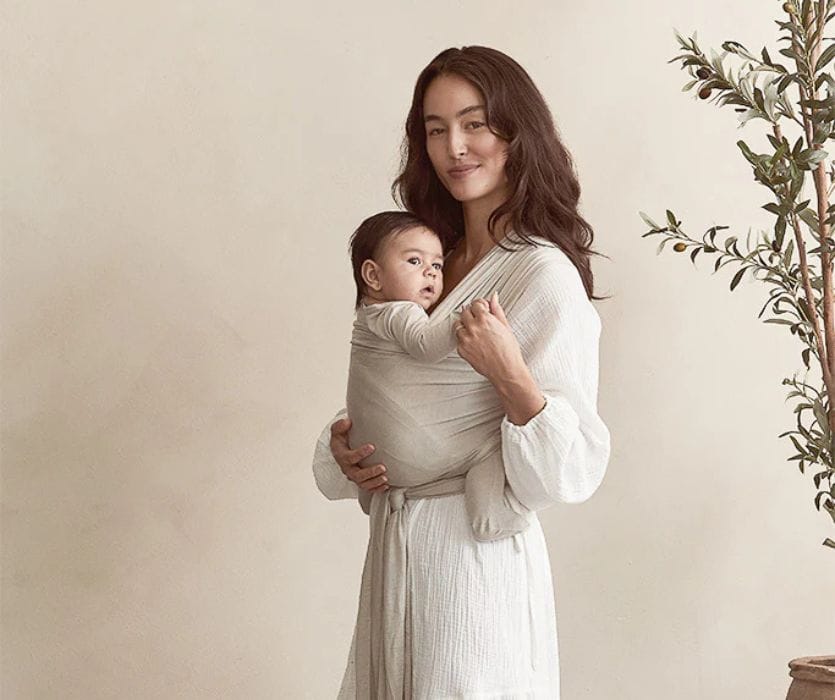
If soft structured carriers are the workhorse of babywearing, stretchy wraps are the warm hug of the newborn stage. They're snuggly, forgiving, and remarkably good at soothing a baby who just wants to be held. Many parents describe them as the thing that got them through the first few months with their sanity intact.
They also have a natural end of life, and knowing that going in saves a lot of frustration later. Here's everything you need to know.
What you'll find here:
- What a stretchy wrap actually is
- How to wear your baby in one
- Age and size range (and why it matters)
- Honest pros and cons
- Hybrid options for those who want something simpler
- How to know if this is the right type for you
- Brands worth knowing about
What Is a Stretchy Wrap?
A stretchy wrap is a long piece of knit fabric – usually around 16 feet (5 meters) – that you tie around yourself and your baby. Knit fabric stretches in all directions, which is what gives stretchy wraps their signature soft, mold-to-your-body feel. Different brands have more or less stretch, but they all belong to the same family.
Most stretchy wraps are one-size-fits-most, which means the same wrap works for wearers of different sizes – a genuine advantage when you're sleep-deprived and don't want to think about fit.
You've probably heard of Solly Baby, Boba Wrap, and Moby. Those are all stretchy wraps.
How Do You Wear Your Baby in One?
Stretchy wraps require three layers of fabric over your baby, which provides the structure and support. The most common carry is called a Pocket Wrap Cross Carry (PWCC) — most brands include this in their instructions under their own name, like "hug hold."
The positions available in a stretchy wrap are more limited than other carrier types. Most work best for:
Front carry, facing in — The primary position and the one you'll use most. Baby faces your chest, knees higher than bottom, supported snugly against you.
Front carry, facing out — Technically possible but generally not recommended. The three-layer construction makes it difficult to achieve a safe, supportive position for an outward-facing carry. If forward facing is important to you, a different carrier type will serve you better.
Stretchy wraps are not suitable for back carries.
What Age and Size Can Use One?
Most stretchy wraps are rated from around 8 lbs up to 25–35 lbs. In practice, most parents find them comfortable and supportive up to around 15 lbs – not because they become unsafe after that, but because the stretch that makes them so lovely for newborns starts working against you as your baby gets heavier. The fabric can feel saggy and unsupportive, and getting a tight enough wrap becomes increasingly difficult.
For most babies this means a stretchy wrap works beautifully from birth through roughly 3–4 months, then it's time to transition to something more structured. That's not a failure – it's exactly what they're designed for.
The Honest Pros and Cons
What stretchy wraps do really well:
They're genuinely great for newborns. The soft, stretchy fabric molds around a tiny baby in a way buckle carriers simply can't replicate. Many newborns who resist other carriers settle immediately in a stretchy wrap.
They can be pre-tied. You tie the wrap around yourself before you leave the house, then pop baby in and out as needed without re-wrapping in a parking lot. This is a bigger deal than it sounds.
They're affordable. Most stretchy wraps fall in the $30–$75 range, making them one of the lowest-cost entry points into babywearing.
One size fits most. The same wrap works for different wearers, which makes sharing easy.
Where they fall short:
There's a learning curve. Tying a stretchy wrap correctly takes practice. Most parents need several tries before it feels natural (and doing it in a parking lot or public place adds another layer of challenge). The good news is it clicks fairly quickly.
Three layers means more warmth. In hot or humid climates, three layers of fabric around you and your baby adds up. Lighter fabrics help, but there's no getting around the fact that this is a warmer carry than a ring sling or a single-panel carrier.
Limited positions. No back carries, limited hip carry options, and forward facing isn't practical. If you want versatility, you'll need to add another carrier type eventually.
Shorter lifespan. Once your baby approaches 15 lbs, it's probably time to transition. For a fast-growing baby, that might be sooner than you expect.
What About Hybrid Options?
If the idea of learning to wrap feels daunting, hybrid options exist that try to give you the feel of a stretchy wrap with less actual wrapping. Two types come up most often:
Simplified stretchy hybrids — These are stretchy wraps that have been pre-cut and partially sewn into loops, vests, or pockets to reduce the amount of wrapping required. The Moby Easy Wrap and Baby K'tan fall into this category. They're easier to get on but come with their own tradeoffs — the K'tan is sized (meaning you and your partner can't share one), and neither offers significantly more longevity than a standard stretchy wrap.
Performance hybrids — These are made from material that behaves similarly to a stretchy wrap but offers more support and versatility. The Wrapsody Hybrid Wrap, for example, can be used for back carries — something a standard stretchy wrap can't do. The Didymos Doubleface is another option in this category. These are worth knowing about if you want something that bridges the gap between a stretchy wrap and a woven wrap.
Is a Stretchy Wrap Right for You?
Go for it if:
- You have a newborn or are expecting one soon
- You want something soft and snuggly for the early weeks
- Budget is a consideration
- You're comfortable with a short learning curve
- You live in a mild climate or plan to use it primarily indoors
Maybe look elsewhere if:
- Your baby is already over 15 lbs
- You live somewhere very hot and humid
- You want one carrier to last from birth through toddlerhood
- Back carries are important to you
Brands Worth Knowing About
Solly Baby One of the most popular stretchy wraps for the newborn stage. Lightweight modal fabric that's softer and thinner than most competitors — genuinely lovely in warmer weather. Worth noting: the length means it can drag on the ground when you're putting it on in public, which some parents find frustrating. You can find them on the Solly Baby site.
Boba Wrap A reliable, widely available option at an accessible price point. Many parents find it has slightly more stretch than the Solly, which some prefer for a snugger feel. Good first wrap if you want something easy to find and easy to return if it doesn't work for you. You can find them on Boba.com.
Moby Wrap One of the originals and still widely recommended. Similar feel to the Boba. The Moby Easy Wrap (their hybrid version) reduces the wrapping steps if you want something simpler, though you lose some of the versatility of the original. Check them out on the Moby site.
Baby K'tan Pre-sewn loops make it faster to put on than a traditional stretchy wrap — no tying required. The tradeoff is that it's sized, meaning you and your partner likely need different sizes. Worth considering if ease of use is the top priority and sharing isn't a concern. Find them on the Baby K'tan site.
A Note on Heat
Stretchy wraps come up constantly in discussions about hot weather babywearing, usually as something to avoid in high heat. Three layers of fabric is three layers of fabric regardless of the material. If you're in a genuinely hot, humid climate, a ring sling or a single-layer carrier in linen or cotton will be more comfortable for both of you. That said, many parents in warm climates use stretchy wraps successfully indoors or in air conditioning during the newborn stage — just go in with realistic expectations.
Before You Buy
As with any carrier, try before you buy if you can. Stretchy wraps are one of the more forgiving types to buy secondhand since they're fabric with no hardware to wear out. Just check for thinning, pilling, or loss of stretch before purchasing used.
If you buy one and struggle with the technique, don't give up before watching a few videos or getting a fit check. The learning curve is real but short — most parents feel confident within a week of regular practice.
The Full Series
- Overwhelmed by Baby Carriers? Here's Where to Actually Start
- The Beginner's Guide to Soft Structured Carriers
- Ring Slings: What They Are, How They Work, and Why Parents Love Them
- Beyond the Buckle: A Guide to Woven Wraps and Meh Dais
- What Is an Onbuhimo? Everything You Need to Know About This Underrated Carrier
- Just Tell Me Which Carrier to Buy: A Practical Guide for Overwhelmed Parents
This post may contain affiliate links. If you purchase through my links I may earn a small commission at no extra cost to you. Thanks for supporting Pregnant Chicken — it keeps the lights on and supports our free content. Updated February 2026.
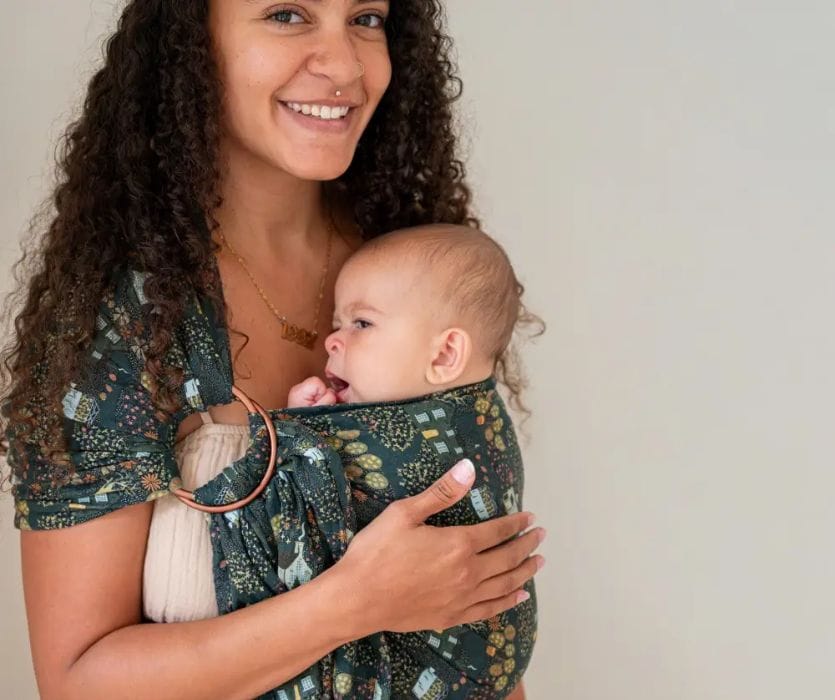
If there's one carrier that consistently surprises parents who try it, it's the ring sling. It looks deceptively simple – just a length of fabric threaded through two rings – and yet it's the carrier that ends up living permanently in most diaper bags, long after the stretchy wrap has been retired and the buckle carrier is reserved for longer outings.
It works for newborns. It works for toddlers. It goes through airport security without making you completely dismantle yourself. And it rolls up small enough to stuff into a corner of whatever bag you're already carrying.
Here's what you need to know.
What you'll find here:
- What a ring sling actually is
- How to wear your baby in one
- Age and size range
- Honest pros and cons
- How to know if this is the right type for you
- A note on heat and fabric choices
- Brands worth knowing about
What Is a Ring Sling?
A ring sling is a single length of fabric with two rings sewn into one end. You thread the fabric through the rings to create an adjustable pouch that holds your baby against your body and is worn over one shoulder.
The adjustment happens entirely through the rings, which means no tying, no buckling, and no pre-wrapping. You thread it, put the baby in, pull the fabric tails to tighten, and you're done. Once you get the hang of it, it genuinely takes about 15 seconds.
Ring slings come in a wide range of fabrics — linen, cotton, hemp, silk, woven wrap fabric — and that choice matters more than it might seem. More on that below.
How Do You Wear Your Baby in One?
Ring slings are worn over one shoulder, with the rings sitting near your collarbone on that side. The fabric spreads across your back and the pouch holds baby against your front or hip.
The main positions are:
Front carry, facing in — Baby faces your chest, knees higher than bottom, head at or above your collarbone. This is the primary newborn position and works beautifully for sleeping babies.
Hip carry — Baby sits on your hip, facing forward or slightly inward. This becomes a favorite position once baby has good head control, usually around 4–6 months. It's one of the most natural feeling carries and lets baby see everything while staying close to you.
Cradle carry — Baby lies horizontally across your body. This position is worth approaching with extra caution — it requires precise positioning to keep baby's airway open, and some babywearing educators advise against it entirely due to airway concerns. If you want to try a cradle carry, get a fit check from a certified babywearing educator before doing so independently.
Most ring slings don't support back carries. If back carrying is a priority, a different carrier type will serve you better.
What Age and Size Can Use One?
This is one of the ring sling's genuine strengths — it truly does grow with your baby. A well-adjusted ring sling works from newborn through toddler, often well past 30 pounds. The adjustment is infinitely variable, which means it accommodates a tiny newborn just as well as a squirmy two-year-old who wants to be up and down every five minutes.
The one-shoulder design does become more fatiguing as your baby gets heavier, which is why most parents transition to a two-shoulder carrier for longer carries with older babies. But for shorter outings, quick ups and downs, and hip carries, many parents use their ring sling regularly well into toddlerhood.
The Honest Pros and Cons
What ring slings do really well:
They're fast. Once you know what you're doing, a ring sling goes on in seconds. There's nothing else in babywearing that matches it for speed.
They're compact. A ring sling folds or rolls into almost nothing. It lives in the bottom of a diaper bag, a tote, a stroller basket — wherever you need it. This makes it the carrier most parents actually have on them when they need it unexpectedly.
They grow with your baby. The infinite adjustability means one ring sling genuinely works from newborn through toddler. You're not buying a newborn carrier and a toddler carrier — you're buying one thing.
They're great for nursing. Many parents find ring slings the easiest carrier type for breastfeeding on the go. The fabric adjusts to lower baby into position and then back up when done, without removing the carrier.
They work beautifully in heat. A single layer of linen or cotton in a ring sling is about as cool as babywearing gets. This is a meaningful difference from a stretchy wrap or padded buckle carrier in hot weather.
Where they fall short:
One shoulder carries all the weight. This is the ring sling's fundamental limitation. For short carries, it's completely fine. For longer outings with a heavier baby, it gets tiring — and if you don't spread the fabric across your shoulder and back properly, it can strain your neck.
There's a learning curve. Not as steep as a woven wrap, but real. Getting the fabric spread correctly, the rings in the right position, and the tightening technique down takes practice. Many parents try a ring sling once, decide it doesn't work, and give up before they've actually learned it. A fit check or an in-person demo makes an enormous difference.
TSA procedures vary. Be prepared to remove your baby from the carrier at security screening. Whether the carrier itself needs to come off depends on the screening method used. Check current TSA guidelines before you fly rather than assuming either way.
Fit is genuinely individual. Ring slings fit differently on different body types, and fabric choice affects how easy they are to learn with and adjust. A sling that a friend loves might not work as well on your body or with your baby.
A Note on Fabric: This Actually Matters
More than almost any other carrier type, the fabric of a ring sling affects how it performs. Here's the quick version:
Linen and cotton are the most recommended starting points. They're breathable, relatively easy to adjust, and hold their position well once tightened. Linen especially is a top choice for warm climates — it gets softer with washing and wears beautifully.
Hemp blends (often hemp-cotton) are durable, supportive, and also great in heat. Slightly more texture than linen, which some parents love and some find scratchy at first.
Woven wrap fabric ring slings are made from the same material as woven wraps — usually a cotton or linen blend in a specific weave. These tend to be the most supportive and are highly adjustable, though they can be stiffer when new and need a break-in period.
Silk is incredibly lightweight and beautiful but slippery, which makes it harder to learn with and harder to keep adjusted. Generally not recommended as a first ring sling.
Muslin is soft and lightweight — great for newborns and warm weather, but less supportive as baby gets bigger.
The general advice from experienced babywearers: start with a linen or cotton ring sling for ease of learning, then branch out once you know what you like.
Is a Ring Sling Right for You?
Go for it if:
- You want something fast and packable for quick outings
- You're in a hot climate and want a cool carrying option
- You plan to nurse on the go
- You want one carrier that genuinely works from newborn to toddler
- You'll be in situations where quick ups and downs matter — grocery runs, chasing a toddler, travel
Maybe look elsewhere if:
- You have significant shoulder or neck issues
- You primarily need a carrier for long carries with a heavy baby
- Back carrying is a priority
Brands Worth Knowing About
Hope & Plum Consistently one of the most recommended ring sling brands in parent communities. Their hemp-cotton blend is supportive, breathable, and gets softer with use. They offer free fit consultations, which is genuinely useful when you're learning. On the pricier side, but worth checking their secondhand platform if budget is a concern. Check them out on the Hope & Plum site.
LoveHeld Comes up frequently as a favorite, particularly their waffle weave fabric which many parents find easier to learn with than traditional woven options. Beautiful designs and a supportive carry. A strong contender if you want something slightly different from the standard linen sling. Find them on their site.
Sakura Bloom A well-established brand with a loyal following. Their linen ring slings are widely loved for their simplicity and quality. You can find them on the Sakura Bloom site.
Girasol A popular recommendation for beginners specifically because of their gradient fabrics, which make it easier to see where to pull when tightening. Generally more affordable than Hope & Plum or LoveHeld, but they are a little tricky to find in North America but a lot of specialty stores carry them. You can check them out on their site.
Wildbird Widely available in mainstream baby stores, which makes them accessible if you want to try a ring sling without ordering online. Mixed reviews in experienced babywearing communities compared to the brands above, but many parents use them happily — particularly for casual use. You can find them on the Wildbrid site.
LennyLamb Their ring slings use woven wrap fabric and are highly regarded for support and longevity. A good option if you want to eventually move into woven wrap babywearing and want your ring sling to feel similar. Find them on the Lenny Lamb site.
Before You Buy
Ring slings are one of the best carrier types to buy secondhand — there's no hardware to wear out, and a gently used sling in good quality fabric is just as good as new. Check for any thinning in the fabric or distortion around the rings before buying used.
If you try a ring sling and struggle with it, please get a fit check before deciding it's not for you. The most common issues — fabric not spread across the shoulder, rings in the wrong position, tightening from the wrong section of fabric — are all fixable with a small adjustment and make the difference between a carrier that hurts and one that feels effortless.
The Full Series
- Overwhelmed by Baby Carriers? Here's Where to Actually Start
- The Beginner's Guide to Soft Structured Carriers
- Stretchy Wraps Are Magic for Newborns — Until They're Not
- Beyond the Buckle: A Guide to Woven Wraps and Meh Dais
- What Is an Onbuhimo? Everything You Need to Know About This Underrated Carrier
- Just Tell Me Which Carrier to Buy: A Practical Guide for Overwhelmed Parents
This post may contain affiliate links. If you purchase through my links I may earn a small commission at no extra cost to you. Thanks for supporting Pregnant Chicken — it keeps the lights on and supports our free content. Updated February 2026.
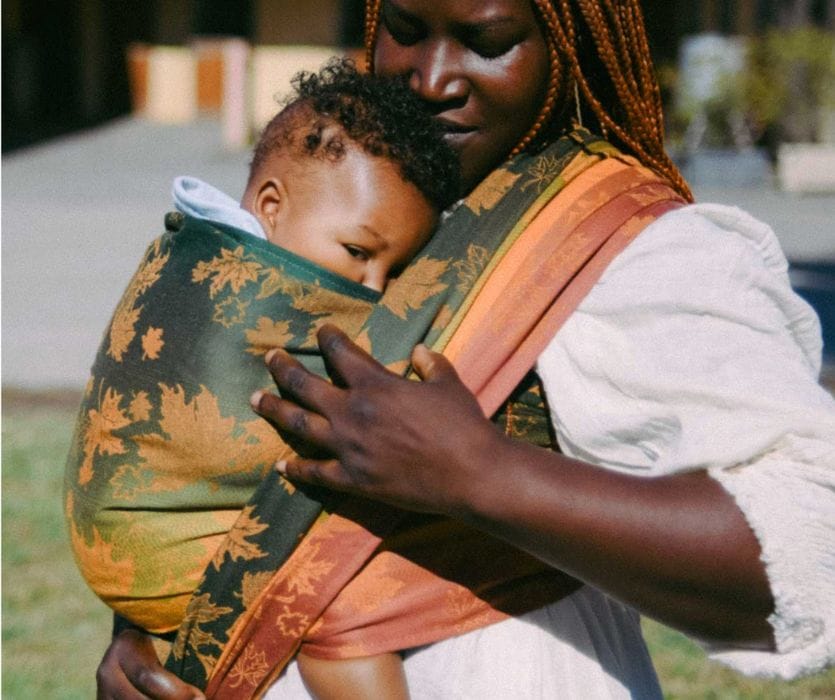
Fair warning: this is the post where babywearing gets a little more involved. Woven wraps and meh dais have a steeper learning curve than anything else we've covered in this series — but they also offer things no other carrier type can. More versatility, more carry positions, more ways to distribute weight comfortably, and for many parents, a genuine enjoyment of the practice itself.
If you're a first-time parent still figuring out the basics, this might be something to bookmark for later. If you've already tried a stretchy wrap or buckle carrier and found yourself wanting more, keep reading.
What you'll find here:
- What woven wraps are and how they differ from stretchy wraps
- How sizing works — and why it matters
- How to wear your baby in one
- What a meh dai is and how it differs from a woven wrap
- Honest pros and cons of each
- A note on cultural context
- How to know if either is right for you
- Brands worth knowing about
What Is a Woven Wrap?
A woven wrap is a long piece of fabric — woven rather than knit, which means it doesn't stretch — that you tie around yourself and your baby. If you have a Moby or Boba Wrap, that's a stretchy wrap and a different thing entirely. Woven wraps are firmer, more supportive, and significantly more versatile.
The lack of stretch is actually what makes them so capable. Because the fabric doesn't give, you can achieve a precise, secure fit that holds its position — which is what allows woven wraps to support back carries, hip carries, and a wide range of positions that stretchy wraps simply can't do.
They come in a wide range of fabrics — cotton, linen, hemp, silk, wool, and blends — and in different weights (measured in grams per square meter, or GSM). Lighter weight wraps tend to be easier to learn with and cooler in warm weather. Heavier wraps are more cushioning and supportive but take longer to break in.
How Does Sizing Work?
This is the part that confuses most people, so let's make it simple.
Woven wraps are sold in numerical sizes — typically 1 through 8 — each corresponding to a specific length. The size you need depends on your body size, your baby's size, and what carry you want to do.
The most important size to know is your base size — the size that lets you do a Front Wrap Cross Carry (FWCC), which is the foundational carry most people learn first. Here's a rough guide to help you find your starting point — keep in mind these are approximate and vary by brand and body shape:
Your clothing size = Approximate base size
XS–S = Size 4–5
M = Size 5–6
L–XL = Size 6–7
XXL+ = Size 7–8
If you're wrapping a larger baby or toddler, round up a size. If you're larger-chested than average, round up as well.
Your base minus 2 (so a size 4 if your base is 6) is the second most useful size to own — it works for a ruck back carry and many hip and front carries once you're more experienced.
The reason babywearers use "base" as shorthand is that it eliminates body size from the conversation. Whether your base is a 4 or an 8, you can all do the same carries in your base size. It's a common language that makes it easier to get advice and find the right wrap regardless of your size.
How Do You Wear Your Baby in a Woven Wrap?
This is where woven wraps genuinely shine. The range of carry positions is broader than any other carrier type:
Front carries — including Front Wrap Cross Carry (the most common starting point), kangaroo carry, and others.
Back carries — including the ruck back carry, which many parents find more comfortable than any front carry once baby is bigger. Back carries in a woven wrap can be done from the newborn stage by experienced wrappers, though most people start with front carries and work up.
Hip carries — excellent for babies who want to see the world without the limitations of forward facing.
The Front Wrap Cross Carry is where almost everyone starts, and for good reason — three layers of fabric mean even an imperfect first attempt is generally safe, which gives beginners room to learn without as much anxiety about getting it exactly right.
What Is a Meh Dai?
A meh dai (sometimes written mei dai, though meh dai is the preferred spelling — more on that below) is a rectangle of fabric with two sets of straps: one that ties around your waist and one that goes over your shoulders. Think of it as a halfway point between a woven wrap and a buckle carrier — it has the structured panel of an SSC but ties with fabric straps rather than buckles.
Meh dais are significantly easier to learn than woven wraps while still offering much of the same versatility. They can be used for front and back carries, work for newborns through toddlers, and are adjustable enough to fit a wide range of body types. For parents who like the idea of wrapping but feel intimidated by the learning curve of a full woven wrap, a meh dai is often the perfect middle ground.
A Note on Language and Cultural Context
Both the meh dai and the onbuhimo (covered in the next post) have roots in Asian babywearing traditions that predate modern carrier brands by centuries. The language we use to talk about them matters.
Meh dai is Cantonese. Bei dai is Mandarin. The spelling "mei tai" was a translation error that became widespread — meh dai is more accurate and preferred. Some brands have created their own trademarked terms (like "Fly Tai") that erase these cultural roots. The babywearing community generally asks that you use the actual term — meh dai — rather than brand-created alternatives, for the same reason you'd use someone's actual name rather than a nickname they didn't ask for.
This isn't meant to make anyone feel bad for not knowing — most people don't, because brands don't tell you. It's just worth knowing going forward.
The Honest Pros and Cons
Woven Wraps
What they do really well:
Maximum versatility. No other carrier type offers as many carry positions or as much ability to customize the fit for your specific body and baby.
Genuinely cool carrying option. A single-layer carry in a lightweight linen wrap is one of the coolest babywearing options available — especially compared to stretchy wraps or padded buckle carriers.
Grows with your baby. A good woven wrap works from newborn through toddler and beyond. It's a genuine do-it-all carrier for parents willing to invest time in learning.
Can be beautiful. This sounds frivolous but it's real — woven wraps come in extraordinary designs and textures, and many parents genuinely enjoy collecting and using them. It becomes a hobby for some people.
Where they fall short:
Steep learning curve. This is the honest truth. A woven wrap takes real practice to use well. Most parents need several weeks of regular use before it feels natural, and some positions — particularly back carries — take considerably longer.
Tails touch the ground. On wet or muddy days, the fabric tails will trail on the ground while you're tying. It's a minor inconvenience that comes up often enough to be worth mentioning.
Not quick on/off. If you need to get baby in and out frequently, a woven wrap is not your most practical option. A ring sling or buckle carrier will serve you better for quick trips.
Requires the ability to tie knots. For parents with arthritis or limited hand mobility, this can be a genuine barrier.
Meh Dais
What they do really well:
Easier learning curve than a woven wrap. The waist ties anchor the carrier in place, which makes it easier to get baby positioned correctly before tying the shoulder straps. Most parents feel confident within a few practice sessions.
Highly adjustable. Because nothing is pre-sewn into a fixed size, a meh dai can accommodate a very wide range of body types and baby sizes.
Versatile. Front and back carries, newborn through toddler. Some meh dais can also do hip carries.
Minimalist feel. No buckles, minimal padding — many parents prefer the cleaner look and feel.
Where they fall short:
Straps touch the ground. Same issue as woven wraps — tying involves fabric on the ground, which is less fun on wet days.
Minimal padding. Whether this is a pro or con depends entirely on your preferences. Some parents love the streamlined feel; others miss the cushioning of a buckle carrier for longer carries.
Not as quick as a buckle carrier. Faster than a woven wrap, but still involves tying. Not the best choice if speed is the priority.
Is a Woven Wrap or Meh Dai Right for You?
Consider a woven wrap if:
- You want maximum versatility and are willing to invest time in learning
- You plan to carry for a long time and want to keep options open as baby grows
- You live somewhere hot and want a genuinely cool single-layer carry
- You enjoy learning a new skill
Consider a meh dai if:
- You like the idea of wrapping but want something easier to learn
- You want the adjustability of a wrap with less fabric to manage
- You're interested in back carrying earlier than most buckle carriers allow
- You want something minimalist without buckles and padding
Stick with something else if:
- Quick on/off is your top priority
- You have hand or wrist issues that make tying difficult
- You're in the early newborn stage and just need something simple to start
Brands Worth Knowing About
Woven Wraps
Didymos One of the most established woven wrap brands, with decades of history. Their wraps are well-regarded for quality and longevity. They also make the Didyklick, a half-buckle that uses woven wrap fabric for the shoulder portion — a good bridge between a meh dai and a buckle carrier. You can see all the varieties on their site.
LennyLamb Highly recommended across parent communities for quality, design variety, and accessibility. Their wraps come in a wide range of weights and fabrics, making it easier to find a good starting point. Also makes the LennyLight SSC, so a good brand to know if you want to stay within one ecosystem. You can find them on the LennyLamb site.
Oscha A Scottish brand with a devoted following, known for beautiful designs and high-quality fabric. Their wraps tend to have a longer break-in period but are highly regarded once broken in. The Oscha Bairn (a half-buckle) is frequently recommended as a good entry point into the brand. You can see them all on the Oscha site.
Meh Dais
Girasol WrapMySol Frequently recommended as a beginner meh dai — the woven wrap fabric is supportive and the carry feels secure. I found a nice selection on Little Zen One.
Didymos DidyTai Uses Didymos woven wrap fabric for a supportive, adjustable carry. A good option if you already like the Didymos brand. Again, I found a nice selection on Little Zen One.
Hope & Plum Their meh dai gets mixed reviews compared to their Lark SSC — some parents love it, others find back carries less intuitive. Worth trying before buying if possible. Find them on the Hope & Plum site.
LennyLamb Wrap Tai Uses LennyLamb woven wrap fabric. Supportive and adjustable, consistent with the quality of their other products. Note: they didn't have them on their site and I could only find them on Little Zen One. Not sure if they are phasing them out, redesigning or just low on stock.
Before You Buy
Woven wraps have a secondhand market unlike almost any other baby product — active, organized, and full of people who genuinely love what they're selling. Facebook groups dedicated to woven wrap buy/sell/trade are easy to find and worth joining even before you're ready to buy, just to get a sense of brands, prices, and what's available. Many experienced babywearers buy wraps this way exclusively and find better quality at lower prices than buying new.
One practical note on fabric: if you're brand new to woven wraps, resist the temptation to start with something very thick or stiff, even if it's beautiful. A lower GSM wrap in a simple cotton or linen blend is dramatically easier to learn with.
The Full Series
- Overwhelmed by Baby Carriers? Here's Where to Actually Start
- The Beginner's Guide to Soft Structured Carriers
- Stretchy Wraps Are Magic for Newborns — Until They're Not
- Ring Slings: What They Are, How They Work, and Why Parents Love Them
- What Is an Onbuhimo? Everything You Need to Know About This Underrated Carrier
- Just Tell Me Which Carrier to Buy: A Practical Guide for Overwhelmed Parents
This post may contain affiliate links. If you purchase through my links I may earn a small commission at no extra cost to you. Thanks for supporting Pregnant Chicken — it keeps the lights on and supports our free content. Updated February 2026.
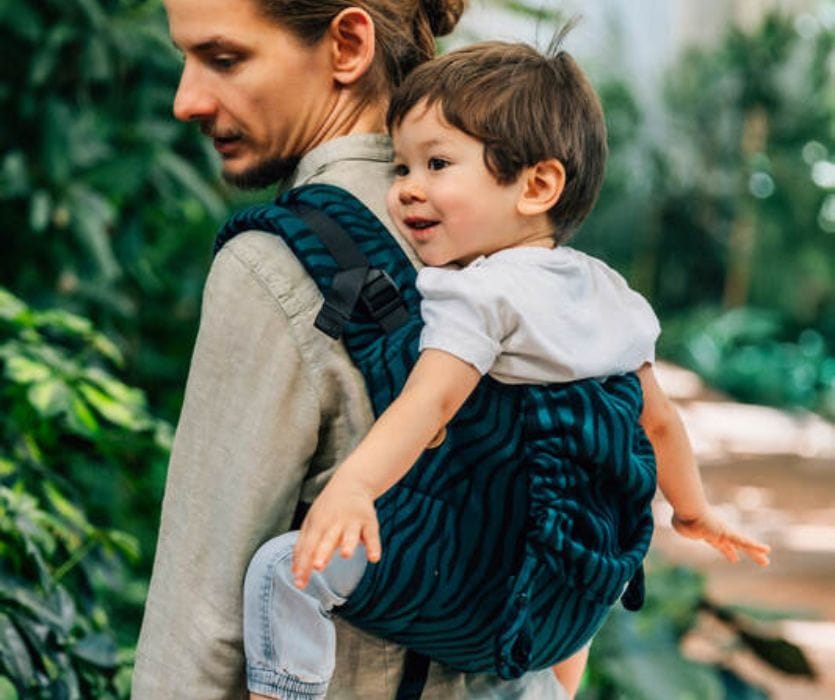
If you've made it this far in our babywearing series, you've probably noticed that onbuhimos don't come up in mainstream baby gear conversations the way buckle carriers or stretchy wraps do. They're not in big box stores. They're not on most registry checklists. And yet, in experienced babywearing communities, they come up constantly (usually from parents saying some version of "I wish I'd found this sooner.")
Here's what they are, who they're for, and whether one deserves a spot in your carrier lineup.
What you'll find here:
- What an onbuhimo actually is
- How it differs from a soft structured carrier
- The three main styles
- How to wear your baby in one
- Honest pros and cons
- A note on cultural context
- How to know if this is right for you
- Brands worth knowing about
What Is an Onbuhimo?
An onbuhimo is a back carrier similar in appearance to a soft structured carrier, but with one significant difference: there's no waistband. Instead, the carrier has a back panel, shoulder straps, and a system of loops or rings that create a seat for your baby without anything wrapping around your midsection.
Onbuhimo (OHN-bu-he-mo) means "back carrying strap" in Japanese — "onbu" refers to the act of carrying on the back, and "himo" means strap or rope. They originated in Japan and have been used for centuries as a practical, everyday back carrying solution.
The absence of a waistband is what defines the onbuhimo experience. It changes how the carrier feels, who it works for, and what situations it's best suited to. For some parents, it's a revelation. For others, it's not the right fit – and knowing the difference before you buy saves everyone time and money.
A Note on Language
As with the meh dai, language matters here. "Onbu" is a verb — it means to carry on the back. It should not be separated from "himo" when referring to the carrier. Saying "I just got an onbu" is a bit like saying "I just got a carry" — it loses the meaning.
Some brands have created their own trademarked terms for onbuhimos that erase the Japanese roots of the carrier. The babywearing community asks that you use the correct term — onbuhimo — rather than brand-created alternatives, for the same reason discussed in our woven wraps post: it's a matter of respect for the culture the carrier comes from.
How Is It Different from a Regular Buckle Carrier?
The simplest way to think about it: an onbuhimo is a buckle carrier that sits entirely on your shoulders with no waistband involved. This sounds like a small difference but it changes the experience significantly.
Without a waistband, all of your baby's weight transfers through your shoulder straps. This means your core and back muscles do more work than they would in a carrier with a waistband — which takes some adjustment, especially if you're used to waistband carriers. Most parents find they build up to longer carries gradually.
It also means the carrier sits differently on your body. There's nothing around your midsection, which makes onbuhimos noticeably cooler, more comfortable during pregnancy, and much easier to sit down in than a traditional buckle carrier.
The Three Main Styles
Buckle onbuhimo — Shoulder straps with buckles, similar to a standard SSC but without the waistband. The most straightforward style and the easiest transition for parents already familiar with buckle carriers.
Ring onbuhimo — Shoulder straps with rings instead of buckles, offering more adjustability. The rings allow for a more customized fit and are particularly popular with parents who want a higher back carry position.
Traditional/reverse onbuhimo — The shoulder straps are made of fabric rather than padded straps, similar to a meh dai. These offer the most adjustability and the most versatility in terms of carry position, but have a slightly steeper learning curve than the buckle version.
How Do You Wear Your Baby in One?
Onbuhimos are primarily back carriers, which is both their strength and their limitation. The main positions are:
High back carry — Baby sits high on your back, their face visible over your shoulder. This is the signature position of the onbuhimo and one of its biggest selling points — the high carry position is comfortable for both wearer and baby, keeps baby close to your center of gravity, and gives baby an excellent view without the limitations of forward facing.
Standard back carry — Similar to a back carry in any buckle carrier, with baby sitting lower on your back.
Some onbuhimos can also be used for front carries, though this varies by style and brand. They are generally not recommended for newborns or babies who cannot sit supported — the back panel creates the seat, and baby needs enough core strength to hold their position safely.
What Age and Size Can Use One?
This is the onbuhimo's main limitation compared to other carrier types. Because there's no waistband creating structure, babies generally need to be able to sit supported before an onbuhimo is appropriate — usually around 6 months, though some parents start earlier with certain styles under guidance from a babywearing educator.
Once baby reaches that milestone, an onbuhimo can typically be used through toddlerhood and beyond. LennyLamb makes a toddler onbuhimo, and Kinderpack's sizing extends to special needs children — so longevity is genuinely not a concern once you're past the newborn stage.
There are some exceptions worth noting: certain ring-style and traditional onbuhimos can be used with younger babies when worn by an experienced babywearer who is comfortable with the technique. If this is something you're interested in, seek out guidance from a certified babywearing educator rather than going it alone.
The Honest Pros and Cons
What onbuhimos do really well:
High back carry position. This is the onbuhimo's signature feature and the reason so many parents wish they'd found it sooner. Baby sits high on your back, close to your center of gravity, with their face over your shoulder. It's comfortable for long carries, keeps baby engaged, and works beautifully for getting things done around the house.
No waistband means real advantages. Cooler to wear, comfortable to sit in, and genuinely wearable during pregnancy. Parents with sensitivity around their midsection — whether post-surgical, postpartum, or just personal preference — often find onbuhimos dramatically more comfortable than waistband carriers.
Compact. No waistband means significantly less material to fold and store. An onbuhimo packs down much smaller than a comparable SSC.
Quick once you know it. Back carries have a reputation for being complicated, but an onbuhimo simplifies the process considerably compared to a woven wrap or meh dai back carry.
Where they fall short:
Not suitable for newborns. This is the biggest limitation for parents looking for one carrier to do everything from birth. An onbuhimo typically can't be your first carrier — you'll need something else for the newborn stage.
All weight on your shoulders. Without a waistband to share the load, your shoulders carry everything. Most parents adapt and build up the relevant muscles, but it's a real adjustment if you're used to waistband carriers — and not the right choice if you have shoulder or neck issues.
Back carries require confidence. Getting baby onto your back safely takes practice, especially in the early days. It's not difficult once you know it, but it does require learning. A babywearing group or educator can help enormously here.
Less versatile than an SSC. If you want one carrier for front carries, back carries, and everything in between from birth, an onbuhimo isn't it. It's a specialist, not a generalist.
Is an Onbuhimo Right for You?
Go for it if:
- Your baby is 6 months or older and you want a comfortable back carry option
- You find waistband carriers uncomfortable — post-surgery, during pregnancy, or just personal preference
- You want something compact and cool for warmer weather
- You're already comfortable with back carrying and want a streamlined option
- You want a high back carry position
Maybe look elsewhere if:
- You have a newborn or young baby who can't yet sit supported
- You have shoulder or neck issues
- You want one carrier that does everything from birth
- You're not yet comfortable with back carries
Brands Worth Knowing About
LennyLamb Makes both a standard and toddler onbuhimo using their woven wrap fabric. Highly regarded for quality, support, and longevity. The toddler version is one of the few carriers specifically designed to grow with older and larger children. You can see them all on the LennyLamb site.
Happy Baby Happy Baby makes an onbuhimo style carrier that is well regarded for being lightweight and comfortable in warmer weather — a good option if heat is a consideration. Note that this is a separate product from their popular OG soft structured carrier, so double-check you're looking at the right one when shopping. You can find them on the Happy Baby website.
Didymos DidyGo Uses Didymos woven wrap fabric in an onbuhimo configuration. Highly adjustable and supportive, consistent with Didymos quality. Note that "DidyGo" is a brand term — the carrier type is an onbuhimo. I found the best selection on Little Zen One.
Before You Buy
Because onbuhimos require back carries, they're one of the carrier types that benefits most from in-person guidance before you commit. A babywearing group or educator can help you get baby onto your back safely and confidently — which makes the difference between loving the carrier and feeling anxious every time you use it.
Buying secondhand is a smart approach here too. Onbuhimos hold their value well but are often available at a significant discount compared to new, especially through babywearing buy/sell/trade groups.
The Full Series
- Overwhelmed by Baby Carriers? Here's Where to Actually Start
- The Beginner's Guide to Soft Structured Carriers
- Stretchy Wraps Are Magic for Newborns — Until They're Not
- Ring Slings: What They Are, How They Work, and Why Parents Love Them
- Beyond the Buckle: A Guide to Woven Wraps and Meh Dais
- Just Tell Me Which Carrier to Buy: A Practical Guide for Overwhelmed Parents
This post may contain affiliate links. If you purchase through my links I may earn a small commission at no extra cost to you. Thanks for supporting Pregnant Chicken — it keeps the lights on and supports our free content. Updated February 2026.
You’ve made it through the whole series. You know what a stretchy wrap is, you understand the difference between an H-back and an X-back, and you’ve learned that an onbuhimo is not, in fact, a type of sushi. Now comes the part everyone actually wants: just tell me what to buy.
Here’s the thing: there genuinely isn’t one right answer. But there are right answers for specific situations, and that’s what this post is for. Answer a few honest questions about your life, and the decision gets a lot clearer.
What you’ll find here:
- The questions worth asking before you buy anything
- Recommendations by situation
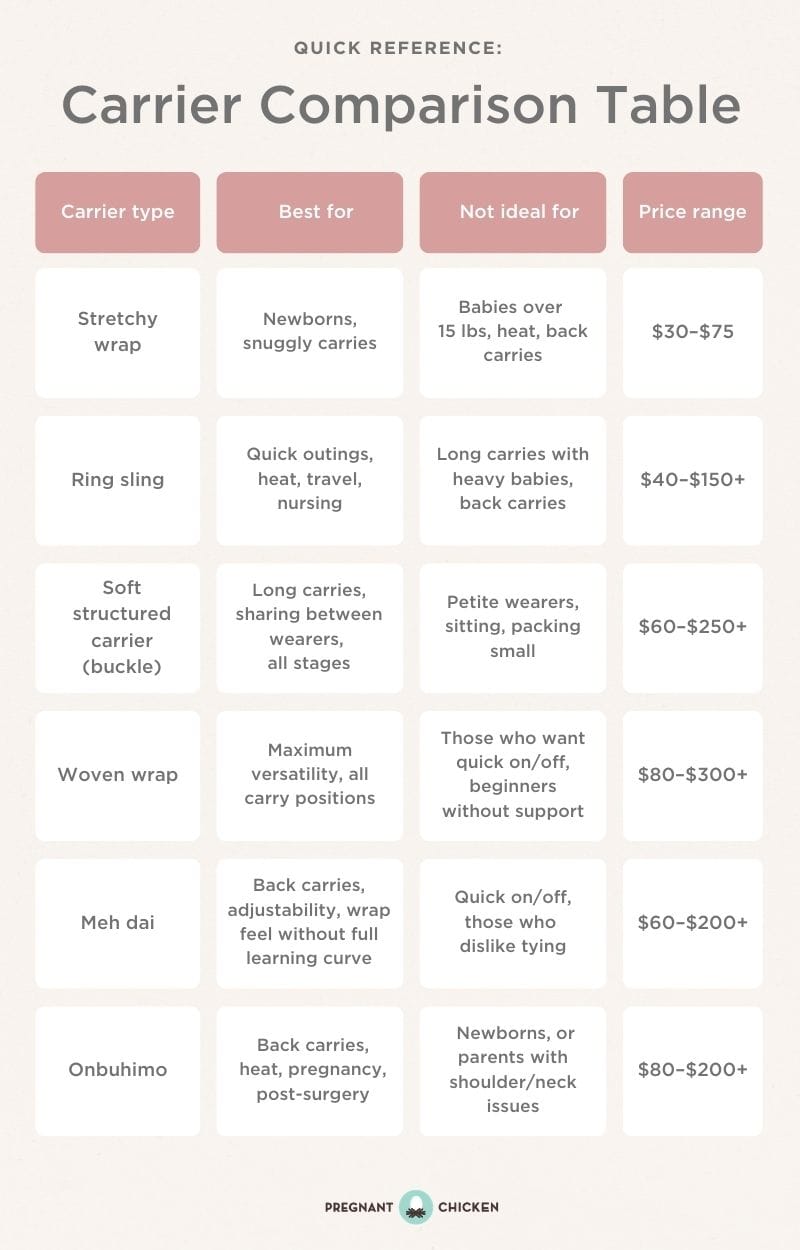
- A quick-reference carrier comparison table
- The smartest ways to buy
- What to do if your carrier isn’t working
Start Here: The Questions That Actually Matter
Before you look at a single carrier, answer these:
How old is your baby (or when are they due)? This matters more than almost anything else. A newborn has completely different needs than a six-month-old, and some carriers simply don’t fit safely until baby reaches a certain size or developmental milestone.
What’s your climate like? Heat is one of the most common reasons parents end up with a carrier they don’t use. Natural fibers in a hot climate make a real difference.
Will you be sharing the carrier with a partner? Some carriers are sized (meaning one size fits one person), and some adjust broadly enough to share easily. If sharing matters, this needs to be a filter.
What are you primarily using it for? Long walks and hikes have different requirements than quick grocery runs or working from home. Be honest about your actual life, not your aspirational one.
What’s your budget? A good carrier doesn’t have to be expensive — especially secondhand. But knowing your budget upfront keeps the decision focused.
How do you feel about a learning curve? Some people love learning a new skill. Others want to buckle and go. Neither is wrong, but they point toward different carrier types.
Recommendations by Situation
“I have a newborn and just need something that works right now.”
Start with a stretchy wrap or the Ergobaby Embrace. Both are soft, snuggly, and genuinely well-suited to the newborn stage. The stretchy wrap has a learning curve but is more affordable and versatile. The Embrace is faster to put on but has a shorter lifespan.
If you want to skip the newborn-specific carrier and go straight to something that grows with your baby, the Tula Free to Grow and Ergobaby Omni Classic or Omni Deluxe both fit from birth without an insert and will take you well into toddlerhood.
For newborns in hot climates specifically, a linen ring sling or the Hope & Plum Sprout come up repeatedly as the most comfortable options.
“I want one carrier that grows with my baby from birth through toddlerhood.”
Tula Free to Grow is the most universally recommended option at an accessible price point. Fits from 7–45 lbs, widely available new and secondhand, works for a broad range of body types. Find it here.
LennyLamb LennyLight is a step up in quality and price — softer, more adjustable, and made from natural fibers. Worth the investment if budget allows. Find it here.
Kinderpack (Infant) is the top recommendation for larger babies or parents planning to carry for long periods. More of a specialty purchase but with a devoted following for good reason. Find it here.
If budget is tight, look for any of these secondhand before buying new. All three hold their resale value well, which means the secondhand market has good options at significantly lower prices.
“My partner and I want to share a carrier.”
Avoid sized carriers like the Baby K’tan. Almost everything else — buckle carriers, ring slings, woven wraps, meh dais — adjusts broadly enough to share between wearers of significantly different sizes.
The Tula Free to Grow, Kinderpack, and Hope & Plum Lark all come up frequently as carriers that work well for wearers of very different sizes without significant readjustment time.
“I live somewhere hot and humid.”
Prioritize natural fibers — linen, cotton, hemp — over synthetic materials or heavily padded carriers. A few honest truths here: babywearing will always be warm, and there is no magic carrier that makes it completely cool. But the difference between a linen ring sling and a padded synthetic buckle carrier in July is real and significant.
Top picks for heat: linen ring sling (Hope & Plum, Girasol, or LoveHeld), Happy Baby OG in linen, Hope & Plum Lark (hemp-cotton blend), or Kinderpack with cool knit mesh.
Avoid: all-mesh synthetic carriers (counterintuitively hotter than natural fibers), heavily padded SSCs, and stretchy wraps with multiple layers in direct sun.
“I want something quick and packable for outings and travel.”
Ring sling — rolls up to almost nothing, goes on in seconds, works from newborn to toddler. The single best answer for parents who want something that’s always in the bag. Find one here.
Hope & Plum Lark — folds down much smaller than most SSCs, apron waist is comfortable for sitting, and easy to share between wearers. Find it here.
Happy Baby OG — lightweight, folds to almost nothing, and highly regarded for comfort on longer outings. Find it here.
Integra Solar — comes up specifically for travel: water resistant, packs tiny, has a hood, and dries quickly. A niche pick but worth knowing about if you travel frequently. Find them here.
For flying specifically: a ring sling is the most practical airport carrier — fast on and off, doesn’t take up luggage space, and works at the gate, on the plane, and everywhere in between. TSA procedures vary — be prepared to remove your baby from the carrier at security, though whether the carrier itself needs to come off depends on the screening method. Check current TSA guidelines before you fly rather than assuming either way.
“I have back pain or physical limitations.”
Look for carriers that distribute weight evenly across both shoulders and your waist. A well-fitted buckle carrier with a proper waistband — Tula Free to Grow, Kinderpack, or LennyLamb LennyLight — is generally the most comfortable option for parents with back issues.
Avoid ring slings for long carries if one-shoulder weight is a concern. Avoid onbuhimos if shoulder or neck issues are a factor.
If you’ve had a c-section and find waistbands uncomfortable in the early weeks, the Ergobaby Embrace or a ring sling avoids pressure on your incision while you recover. The Hope & Plum Lark’s apron waist also sits differently than a traditional waterfall waistband and is more comfortable for many post-surgical parents. That said, always follow your care provider’s guidance about activity after surgery before using any carrier.
Getting a proper fit check is especially important if you have back or physical issues — a carrier that’s even slightly off can make pain worse rather than better, while the same carrier correctly fitted can make a real difference.
“I’m petite and worried about fit.”
This is a genuine concern and worth taking seriously. Heavily padded buckle carriers with rigid waistbands are the most likely to cause fit issues for smaller frames — buckles can fall in awkward spots and waistbands may not tighten down far enough.
Carriers that tend to work better for petite wearers: ring slings (infinitely adjustable, no rigid structure), Hope & Plum Lark (apron waist sits differently than a waterfall waistband), Happy Baby OG (minimalist, adjustable), and meh dais generally (fabric ties rather than fixed hardware).
If you’re petite and want a buckle carrier, the Kinderpack and Tula Free to Grow come up positively in petite parent communities more often than the Ergobaby line.
Trying before buying is especially important here. What looks promising in photos may sit completely differently on a smaller frame.
“I want to be able to do back carries.”
You need a carrier that explicitly supports back carries — not all do. Good options depending on your experience level:
For beginners: Tula Free to Grow, Kinderpack, or Hope & Plum Lark — all support back carries in a buckle or buckle-adjacent format that’s accessible without prior experience.
For those comfortable with some learning: A meh dai allows back carries earlier than most SSCs and gives more adjustability. The Girasol WrapMySol and LennyLamb Wrap Tai are frequently recommended starting points.
For the high back carry specifically: An onbuhimo is the best tool for the job once baby can sit supported. The Kinderpack, LennyLamb, and Naked Panda onbuhimos come up most often.
For maximum versatility: A woven wrap opens up more back carry positions than any other carrier type, but comes with the steepest learning curve.
“Budget is a real concern.”
Good news: you don’t need to spend a lot to babywear safely and comfortably. A few approaches that work:
Buy secondhand. Baby carriers hold their resale value well, which means the secondhand market is full of quality options at significant discounts. Facebook buy/sell/trade groups, Mercari, Poshmark, and eBay are all worth checking. Brands like Tula, Kinderpack, and Hope & Plum are frequently available used.
Start with a stretchy wrap. New stretchy wraps from reputable brands (Boba, Moby) are available for $30–$50 and will serve you well through the newborn stage.
Look for mislisted items. Carriers are frequently mislabeled on Marketplace — a Tula Free to Grow listed as a “Tula standard,” a Kinderpack listed generically as a “soft structured carrier.” If you find something and aren’t sure, ask to see the tag with weight and model information before buying.
Check consignment stores. Once Upon a Child and similar consignment shops sometimes have quality carriers mispriced or misidentified. Worth a look if you have one locally.
The Smartest Ways to Buy
Try before you buy. Truly, this is the single best thing you can do before spending money on a carrier. Look for a local babywearing group or a baby boutique that does fittings. If in-person isn’t possible, several companies offer try-before-you-buy programs by mail.
One note on this: if you’re lucky enough to find a knowledgeable person at a store who spends real time helping you figure out what works for your body and your baby, please buy your carrier from them. Tapping into someone’s expertise and then heading straight to Amazon to save twelve dollars is the kind of thing that closes good local baby stores. And nobody wants that.
Buy secondhand strategically. For fabric carriers with no hardware (stretchy wraps, ring slings, woven wraps), secondhand is an excellent option — there’s nothing to wear out. For buckle carriers, check that all buckles click securely, stitching is intact, and there are no signs of significant wear before buying.
Use retailers’ return windows thoughtfully. If you’re truly unable to try anything in person, ordering from a retailer with a generous return policy lets you experiment at home. Just be disciplined about actually returning what doesn’t work.
Start with one. It’s tempting to buy a newborn carrier and a grow-with-you carrier and a ring sling before your baby arrives. Most experienced babywearers will tell you: start with one, learn it well, and add from there based on what you actually find yourself needing.
What to Do If Your Carrier Isn’t Working
Before you give up on a carrier, try these things:
Get a fit check. Post a photo or video to a babywearing community — Reddit’s r/babywearing, Facebook babywearing groups, or directly to many brands who offer free fit consultations. A surprisingly high percentage of “this carrier doesn’t work” situations are one adjustment away from working perfectly.
Give it more than one try. Most carriers feel awkward the first few times. This is normal. Give yourself at least a week of regular attempts before deciding something isn’t for you.
Check the basics using the TICKS guidelines. The babywearing community uses this acronym as a quick safety checklist for any carrier.
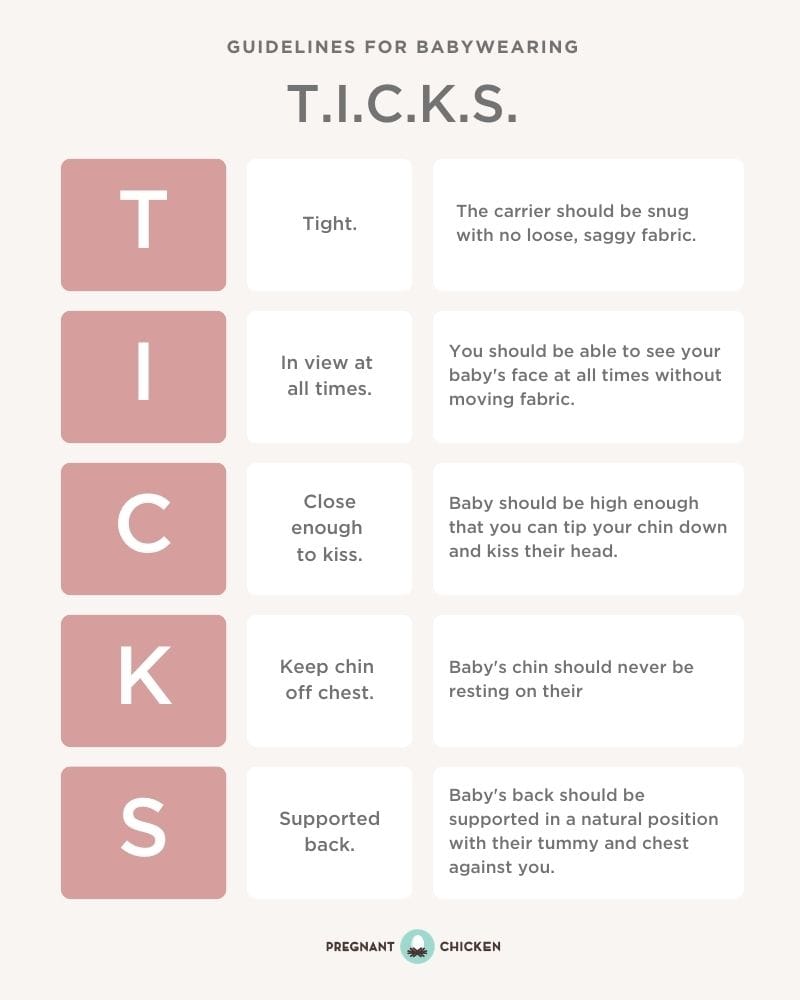
Running through these five checks catches the vast majority of fit issues and takes about ten seconds once you know them. (Personally, it drives me nuts that ‘c’ doesn’t stand for ‘chin off chest’ and ‘k’ doesn’t stand for ‘kissable head’, but I guess as long as we get there, it doesn’t matter what road we take.)
Consider that it might genuinely not be right for your body. Sometimes a carrier that works beautifully for most people just doesn’t fit your specific body well. That’s not a failure – it’s just fit, the same way jeans fit differently on different people. Resell it and try something else.
One Last Thing
If you take nothing else from this guide, take this: the carrier that works is the one that gets used. Not the one that got the best review, or the one your sister swears by, or the one that looks most impressive on a registry. The one that fits your body, suits your baby, and actually makes it out of the house with you. Everything else is just research. Go find yours.
The Full Series
This post may contain affiliate links. If you purchase through my links I may earn a small commission at no extra cost to you. Thanks for supporting Pregnant Chicken – it keeps the lights on and supports our free content. Updated February 2026.
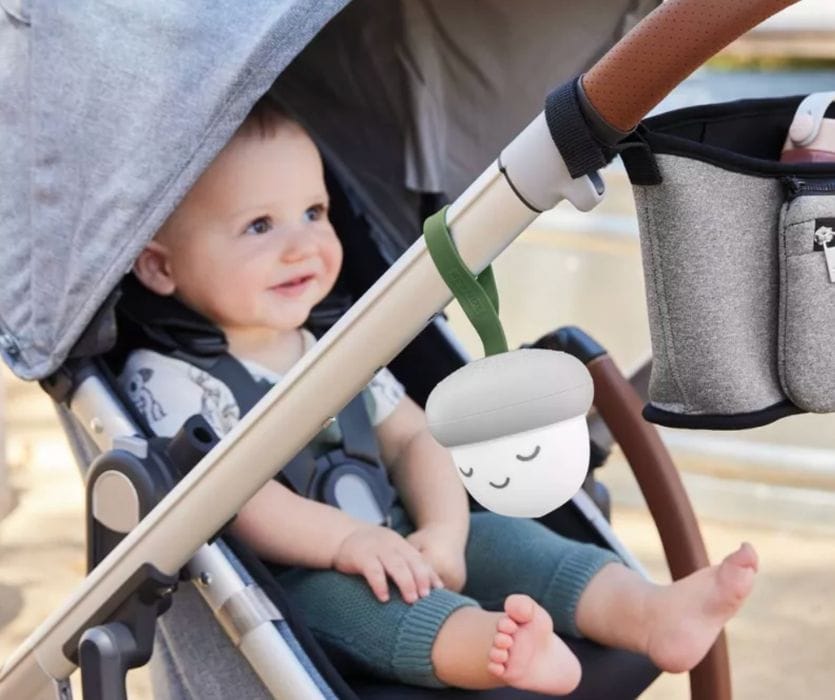
Your stroller is already doing a lot of heavy lifting. But a few well-chosen accessories can take it from "fine" to "how did I ever leave the house without this?" I've been writing about baby gear since 2010 and have two kids who have put a lot of strollers through their paces, so here's what I think is actually worth adding to your stroller setup.What stroller accessories have you added to your setup?
Do Not Touch Tags
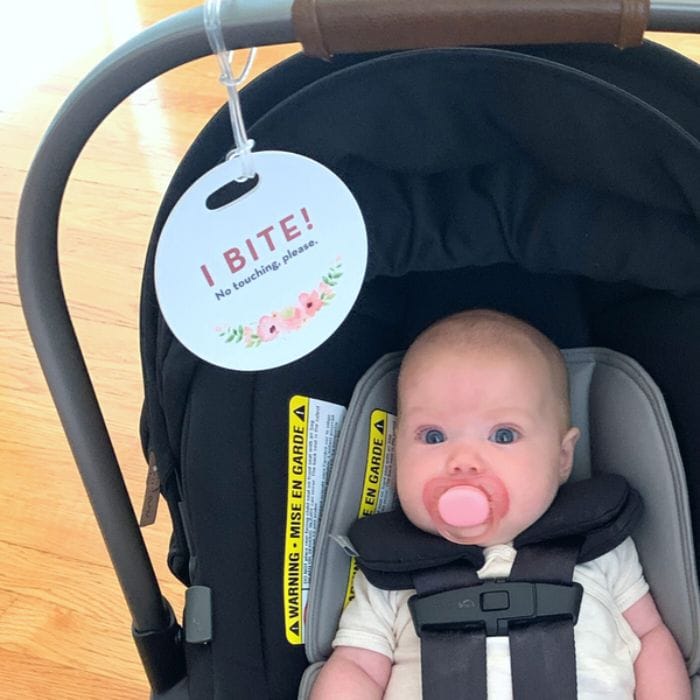
Babies are irresistible, so it's not surprising that well-meaning people often reach in and touch a newborn without thinking about what's on their hands. I came up with these durable signs that can go on a stroller, car seat, or carrier if you are too hoarse from screaming, "keep your filthy hands off my precious baby!" at old ladies at the supermarket. Shop here.
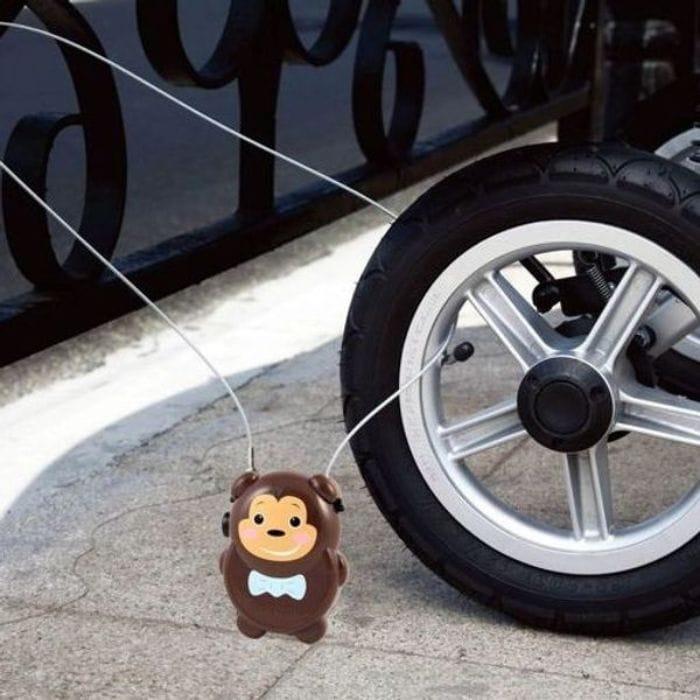
BuggyGuard Stroller Lock
It takes a real piece of work to steal a baby stroller, but they're expensive and it happens more than you'd think. The BuggyGuard has a retractable cable that loops through the wheels and locks to any stationary object, with a combination lock so there are no keys to lose. The compact design tucks away neatly and doesn't interfere with folding. Keep it clipped to your stroller so it's always there when you need it. Shop here.
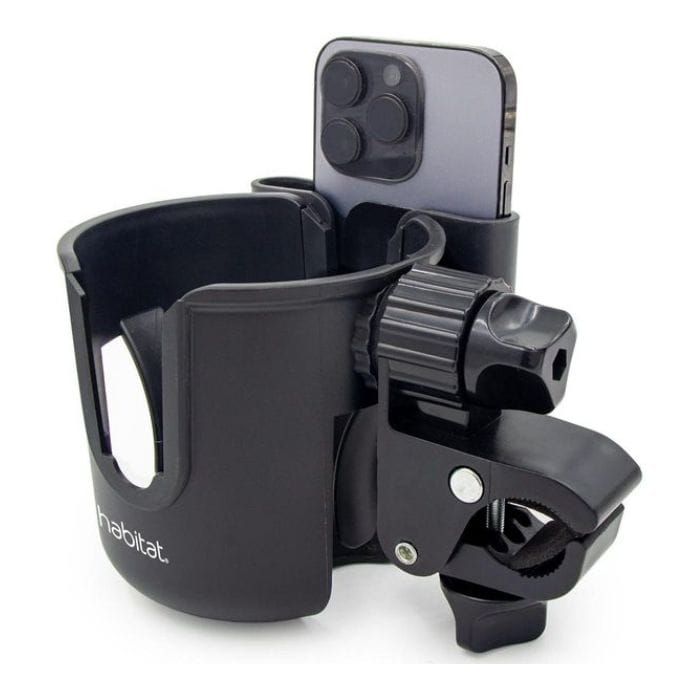
Habitat Stroller Cup Holder with Phone Holder
You will need your coffee, your water bottle, and your phone simultaneously approximately 100% of the time you are walking. This holder keeps all three within reach on your stroller handle, which sounds like a small thing until you've tried to fish your phone out of the bottom of a diaper bag with one hand while steering with the other. Shop here.
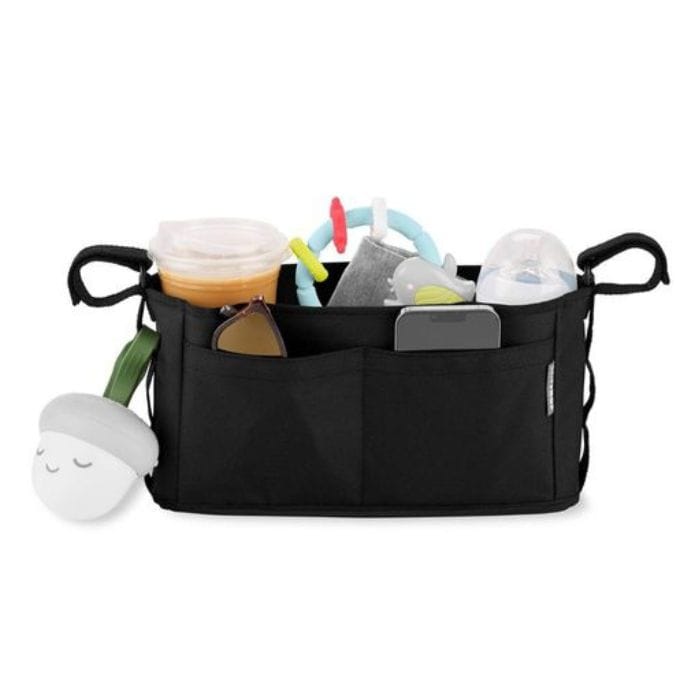
Skip Hop Ultra Stroller Organizer
This is the storage upgrade most strollers genuinely need. Multiple pockets, insulated cup holders, and easy access to wipes, snacks, and your keys — all from the handlebar. If you're the kind of person who likes everything to have a place (or desperately wishes you were), this is your accessory. Shop here.
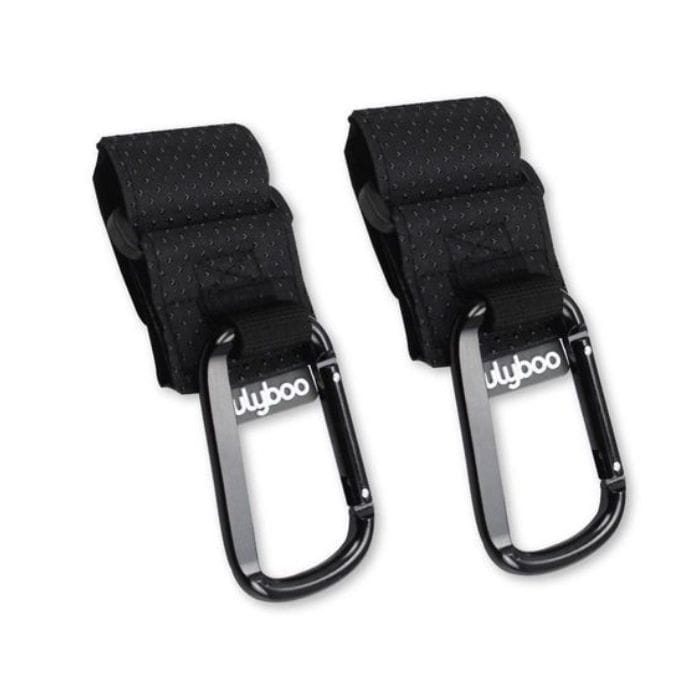
Lulyboo Stroller Hook Clips Set
For everything that doesn't fit anywhere else — shopping bags, a backpack, a tote with 40 things in it. These clips hang from the handlebar and hold a surprising amount. One important note: be mindful of how much weight you pile on, because a back-heavy stroller will tip the moment you let go of the handle, and that's a lesson you don't want to learn with a baby in the stroller. Shop here.
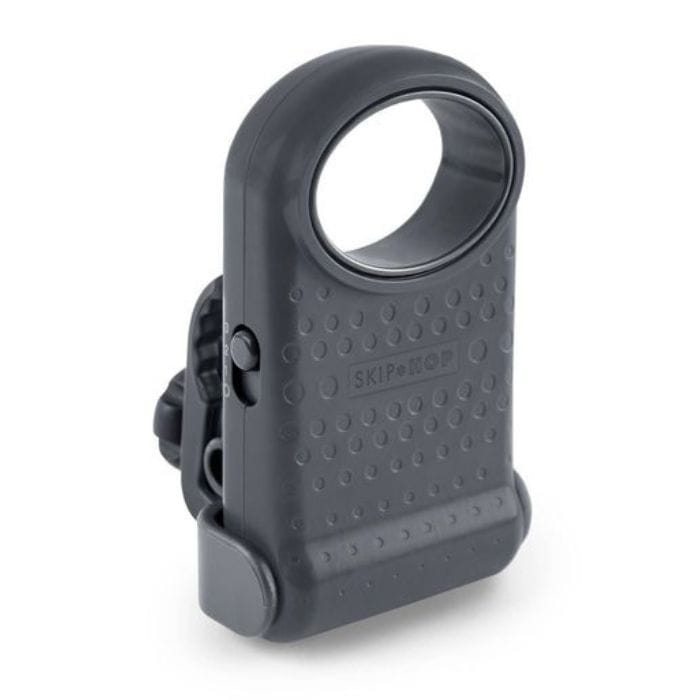
Skip Hop Stroll & Connect Bladeless Stroller Fan
Bladeless is the key word here — no little fingers getting into spinning blades, which is less about safety (most stroller fans wouldn't do any damage) and more about a baby who can't help but fiddle with something that's moving. This fan connects easily to your stroller and keeps air moving. A hot, sweaty, overtired baby is everyone's worst afternoon, and this helps avoid that. Shop here.
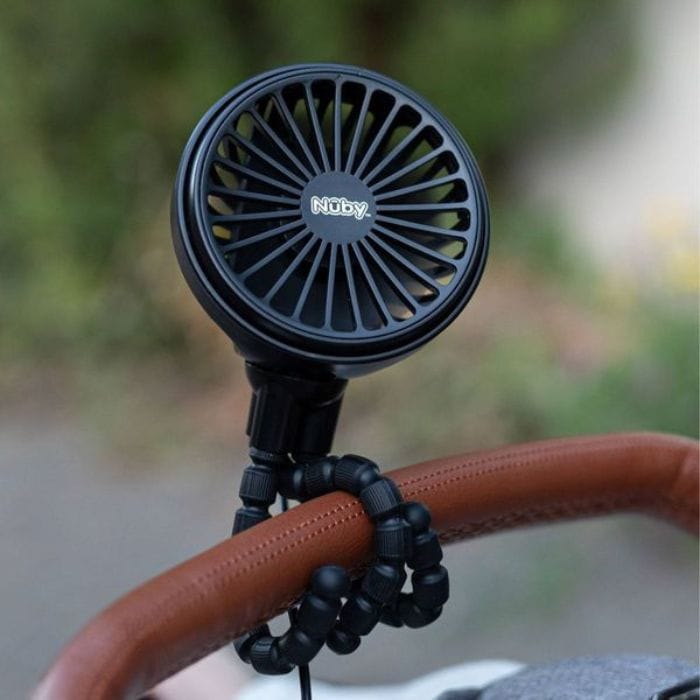
Nuby Stroller Fan
I like this one because it's easy to move around so you get the perfect fan angle. It also delivers a little more breeze than the bladeless if your baby can resist messing with it. Shop here.
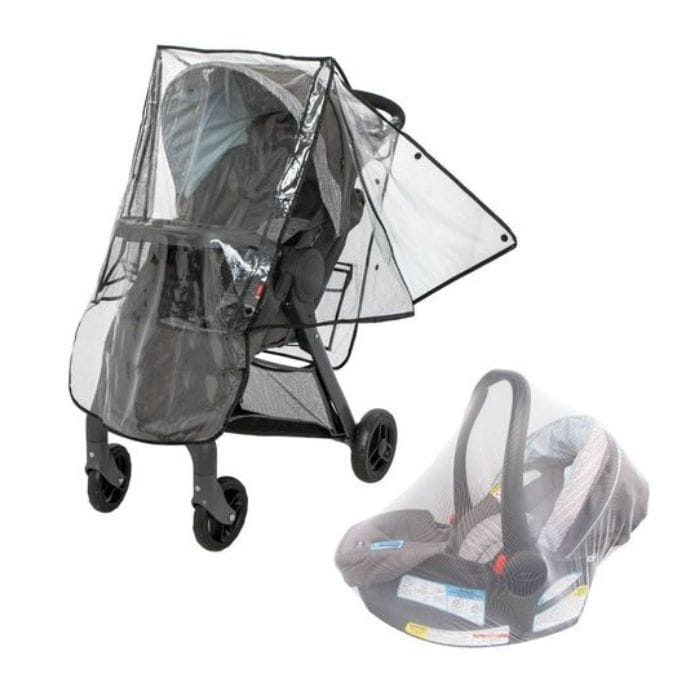
Nuby Eco Stroller Weather Shield & Netting Set
Rain, wind, bugs, and the occasional rogue bee — this shield and netting combo handles all of it. It fits over the stroller to block the elements and keeps flying insects out, which perfect if you're doing any outdoor time in bug season or somewhere tropical. The fact that it doubles as weather protection makes it worth having year-round. Shop here.
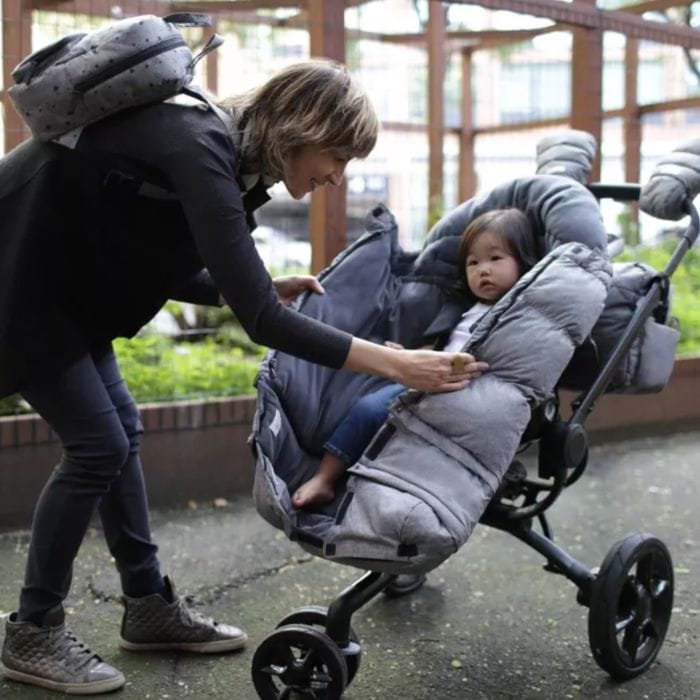
7AM Enfant Blanket 212 Evolution Extendable Footmuff
This is a warm sleeping bag for your baby, and it is wonderful. The adjustable, removable top gives you temperature control, and the extendable footmuff means it grows with your child so you actually get seasons of use out of it. It's pricey so if you just need something for occasional use I'd just use a warm blanket but if you're somewhere with brutal winters, it's a great investment. Shop here.
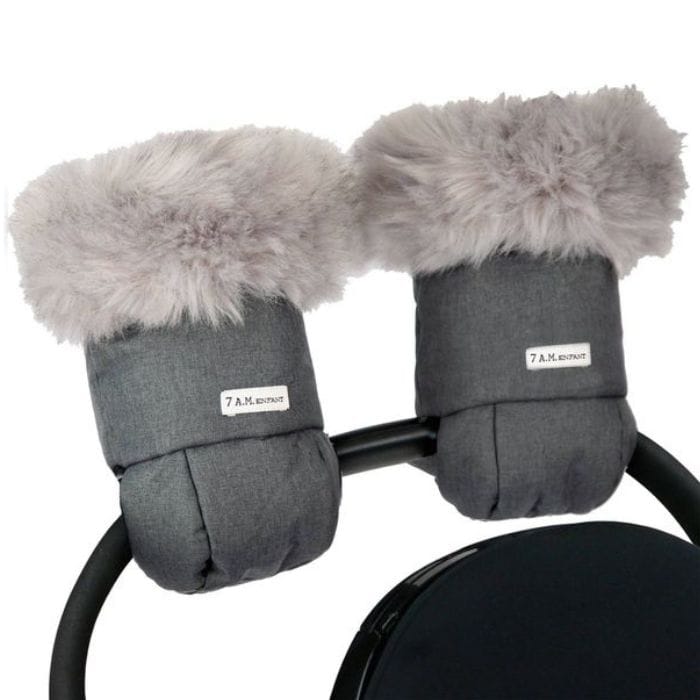
7AM Enfant Warmmuffs Stroller Gloves
These look a little odd at first but they're genuinely brilliant. They stay on the stroller handle — not your hands — which means you can take them off and on without dropping them or losing one on the sidewalk. Easy access to your baby, your phone, your coffee, your dignity. Shop here.
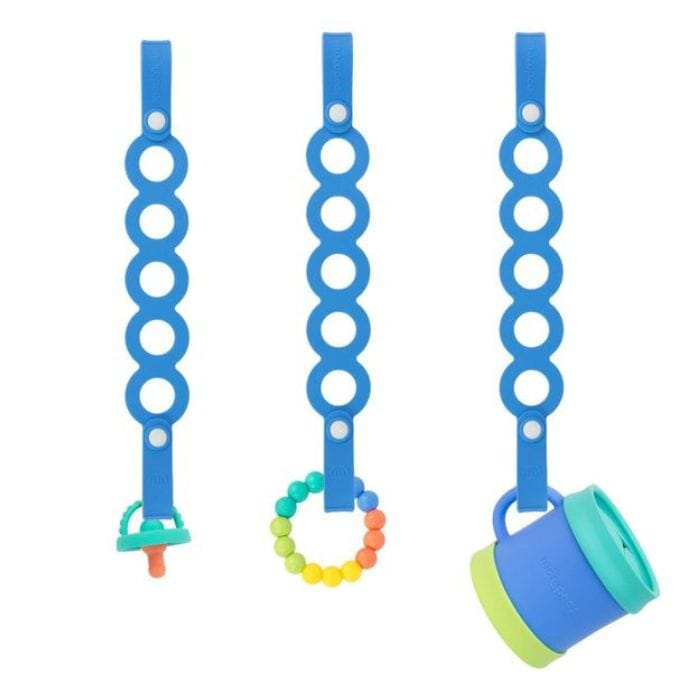
morepeas Baby Toy and Cup Strap
These simple straps attach toys, pacifiers, sippy cups, and teethers to your stroller so that when your baby inevitably flings something as hard as they can toward the ground, it just… bounces. Cheap, effective, and one of those things you'll wonder how you lived without. I like the snaps on these. Shop here.
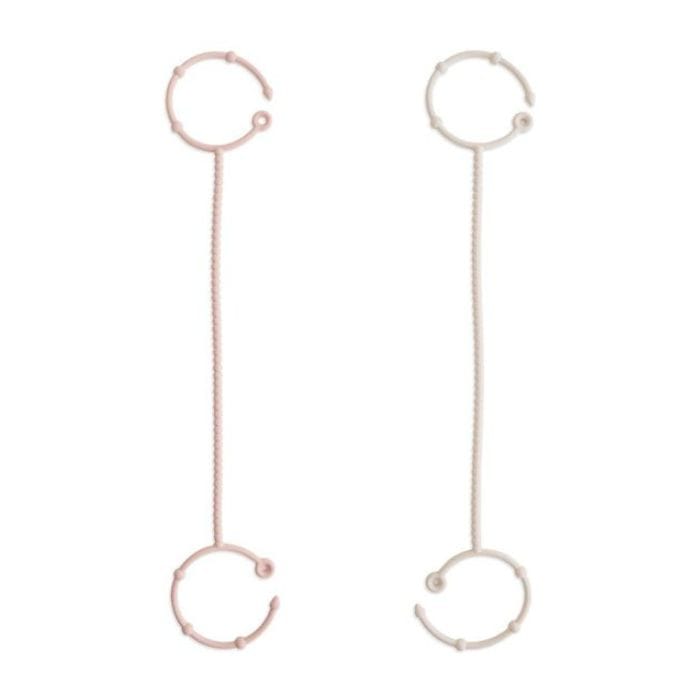
Adjustable Silicone Straps
Here is another version that has a thinner strap and the items attach through a pull through loop vs. the snap. Shop here.
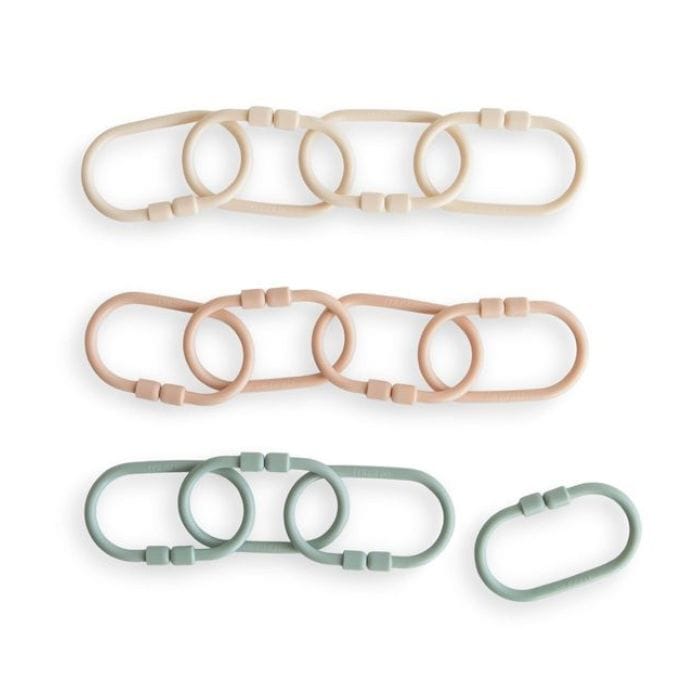
Chian Link Rings
Another option for attaching goodies to the stroller are these rings. I like that you can customize the length. Shop here.
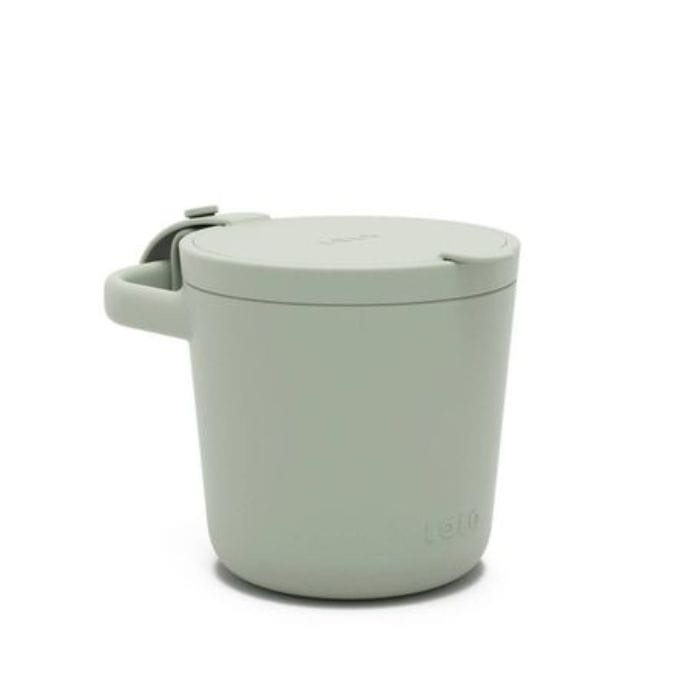
Lalo Snack Cup
This cup is spill-resistant (emphasis on resistant, because nothing with a toddler is truly spill-proof), easy for little hands to dig into, and works great for Puffs, Cheerios, or whatever your child is currently willing to eat. It fits into most cup holders too. Shop here.
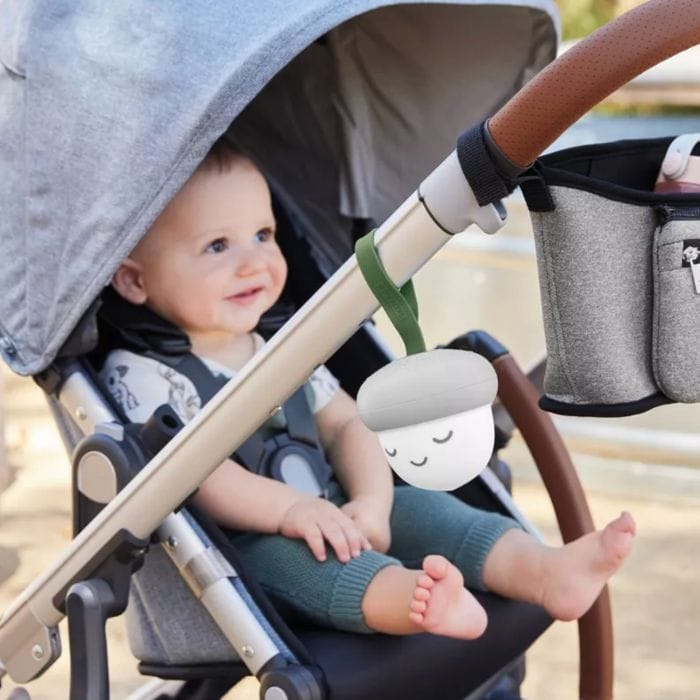
Skip Hop Glow with Me Portable Sound Machine
If your baby has learned to fall asleep to white noise at home (and honestly, good for you for starting that habit early), this little acorn brings that magic on the road. It clips right to the stroller, glows softly, and plays soothing sounds so your baby thinks they're in their crib even when you're navigating a crowded farmers market. The fact that it's shaped like an acorn is completely unnecessary and yet somehow makes it even better. Shop here.
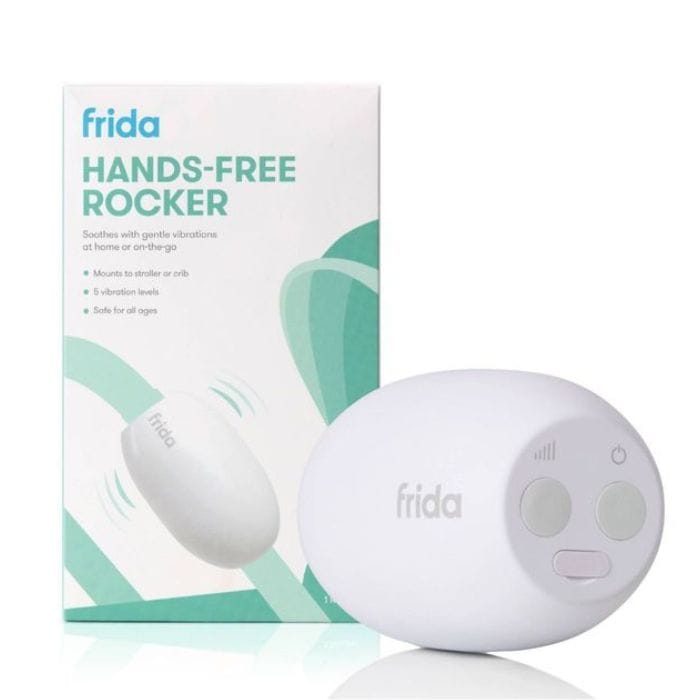
Frida Baby Hands Free Rocker
This one's a bit of a wildcard, but stay with me. Clip it to your stroller or use it at home to keep baby gently rocking while you actually do something with your hands — like drink a full cup of coffee or shake your fists at the sky because you're dealing with a sleep regression. Shop here.
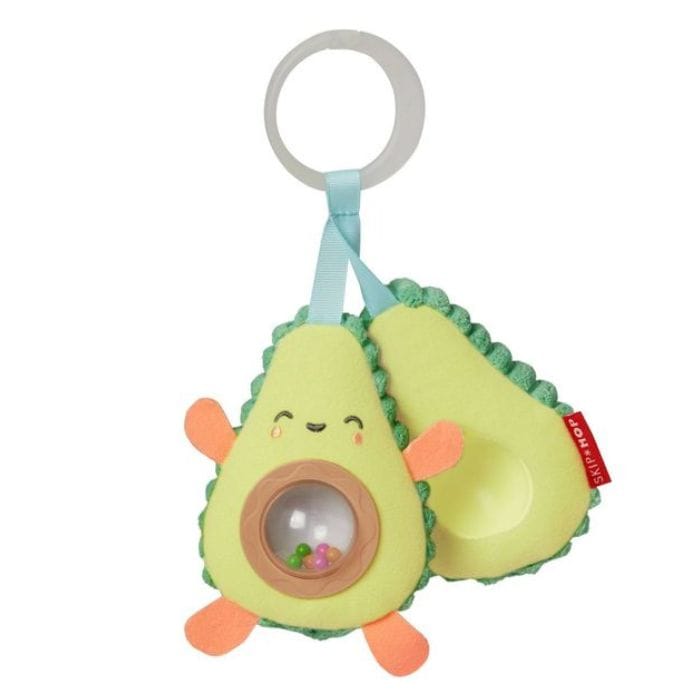
Skip Hop Farmstand Avocado Stroller Toy
Everything for babies is avocado-themed right now and I refuse to be annoyed about it, because this toy is cute and genuinely works. Crinkly, soft, clips right to the stroller, and holds a baby's attention surprisingly well. Shop here.
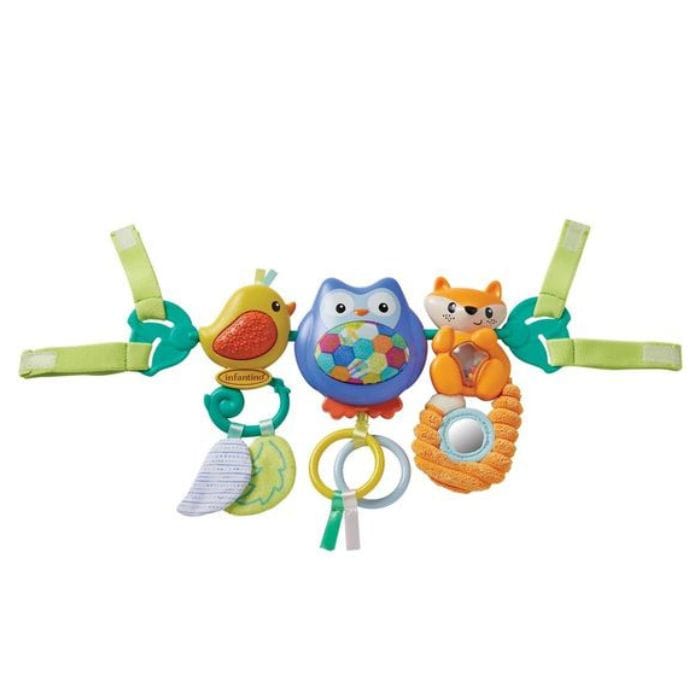
Infantino Go gaga! Musical Travel Bar Activity Toy
This arches over the stroller seat and gives your baby an entire entertainment center to interact with — lights, music, toys to bat at. It's a lot, and babies love it. Great for longer outings when you need your little one engaged and happy. Shop here.
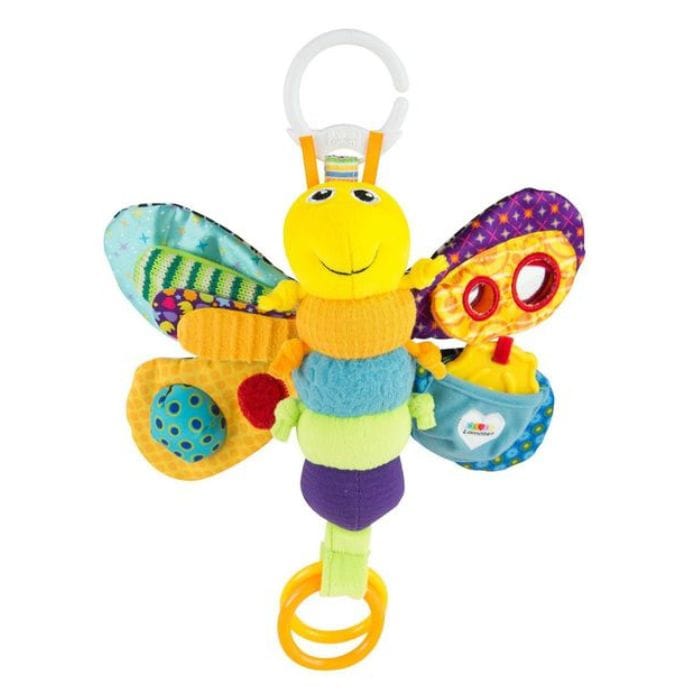
Lamaze Clip & Go Freddie the Firefly
A classic for a reason. Soft, colorful, clips easily to the stroller, and has stayed popular for years because babies are consistently obsessed with it. If you need a straightforward, reliable stroller toy, Freddie is always a good call. Shop here.
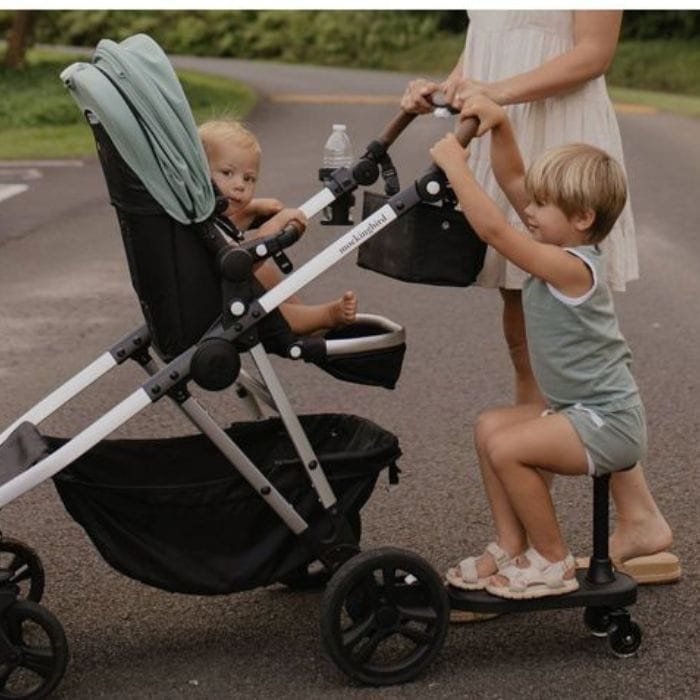
Mockingbird Riding Board Stroller Accessory
For the toddler who wants to walk everywhere right up until the moment they absolutely don't. The Mockingbird board is especially good because it sits off to the side, so you're not kicking it with every step — which if you've ever used a riding board before, you know is a genuine quality-of-life improvement. This one is compatible with the Mockingbird stroller but depending on how your stroller is configured it might work. Shop here.

tagalong Kids' Handle
For the toddler who still needs to stay close and feel like they have a job to do (and also isn't a bolter). This attaches to the stroller and gives them their own handle to hold. They feel like a big kid, you maintain some crowd control, everybody wins. Shop here.
Drop them in the comments – I love finding out what's actually working for people out there.
Related: Mockingbird Stroller Review – Too Good to Be True?
This post may contain affiliate links. If you purchase through my links I may earn a small commission at no extra cost to you. Thanks for supporting Pregnant Chicken — it keeps the lights on and supports our free content. Updated 2026.
Easter is coming right up, so it’s time to get cracking (egg pun intended) if you’re thinking about doing Baby’s First Easter Basket.
Baby’s First Easter Basket Ideas:
I’ve tried to pick things that are relatively inexpensive, small, useful, and have an Easter vibe but can often be used long past the season.
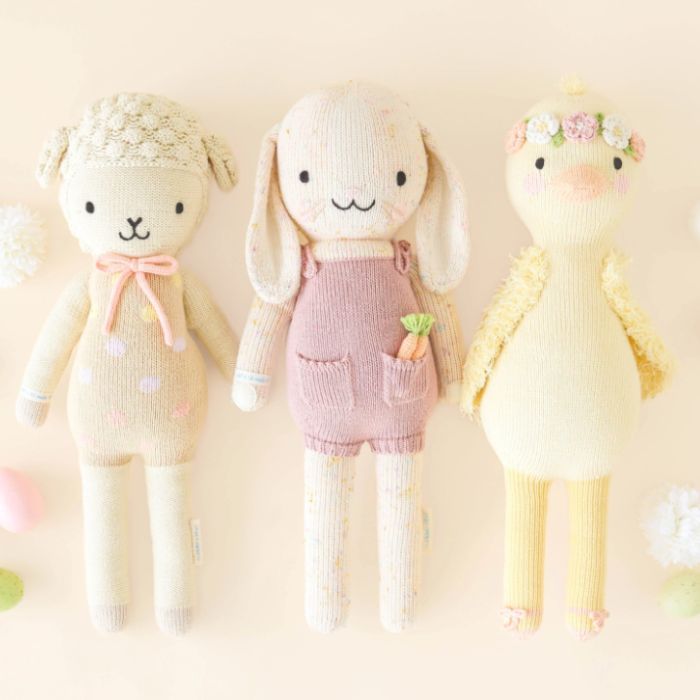
Cuddle + Kind Bunny
Cuddle + Kind makes the most gorgeous stuffed animals and dolls. They are well made and incredibly soft (you can feel the quality when you hold one). In addition to being beautiful, 5-15 meals are provided to children in North America and around the world when you buy one. They sell out VERY quickly, so snap them up when you can. You can check out all the cuteness on their site and on Amazon.
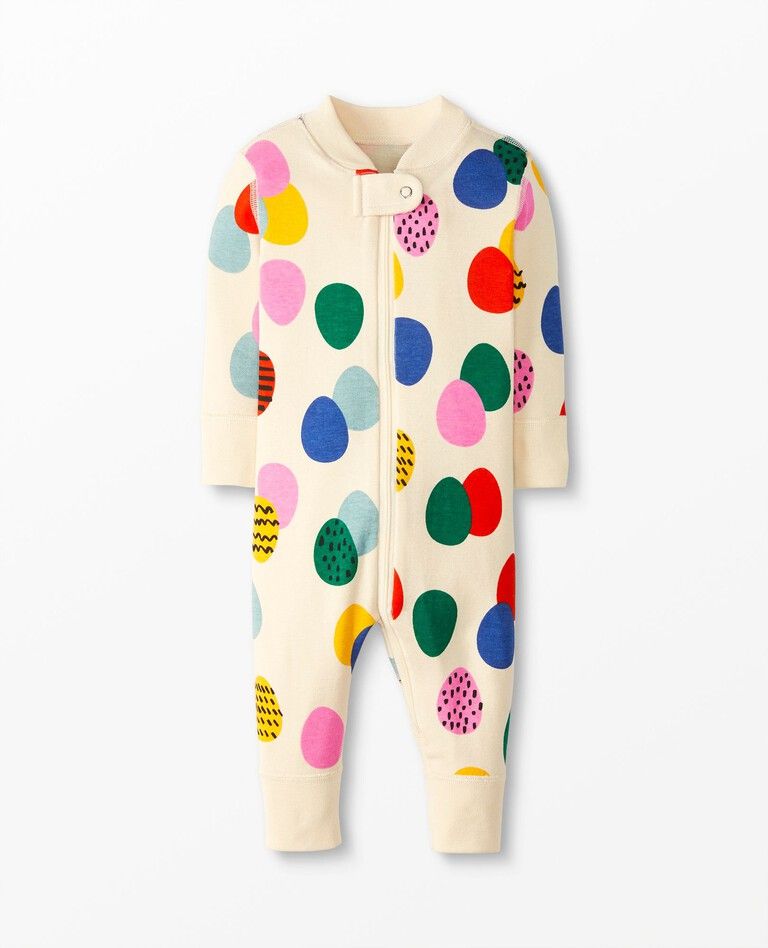
Easter Pajamas
You can never have too many adorable sleepers, and bunnies, ducks, and eggs are kinda universal, so they can wear them past the Easter season. Hanna Andersson makes gorgeous ones but also check out Carter’s and Old Navy for some equally cute styles.
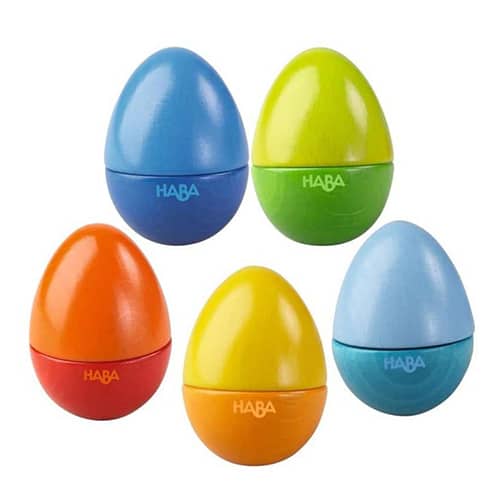
Haba Musical Eggs
Each of these wooden eggs makes a different sound and are perfectly sized for little hands. Four eggs shake (2 rattle, 1 chirps, 1 jingles) and the light blue egg twists to make a clicking noise. They are made of beech wood from sustainable forestry in Germany using 100% non-toxic stains. You can find them on the HABA site, on Amazon and at Target.
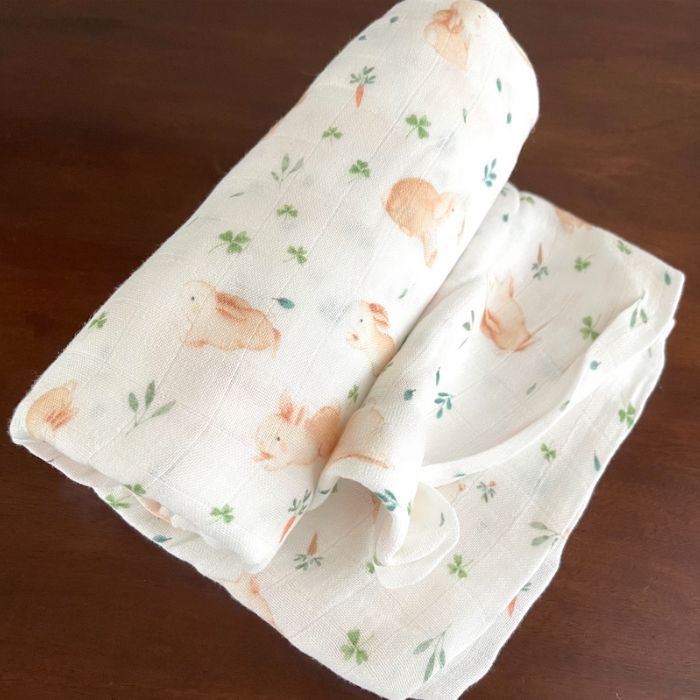
Bunny Meadow Loulou Lollipop
Loulou Lollipop has this gorgeous Bunny Meadow pattern in swaddles, towels, facecloths, and bibs. I love that the single swaddle comes rolled, making it perfect to tuck in an easter basket. If you are looking for something a little more Spring or less soft pink, check out Adventure Begins or Woodland Gnome. (You can also find them on Amazon and at Target.)
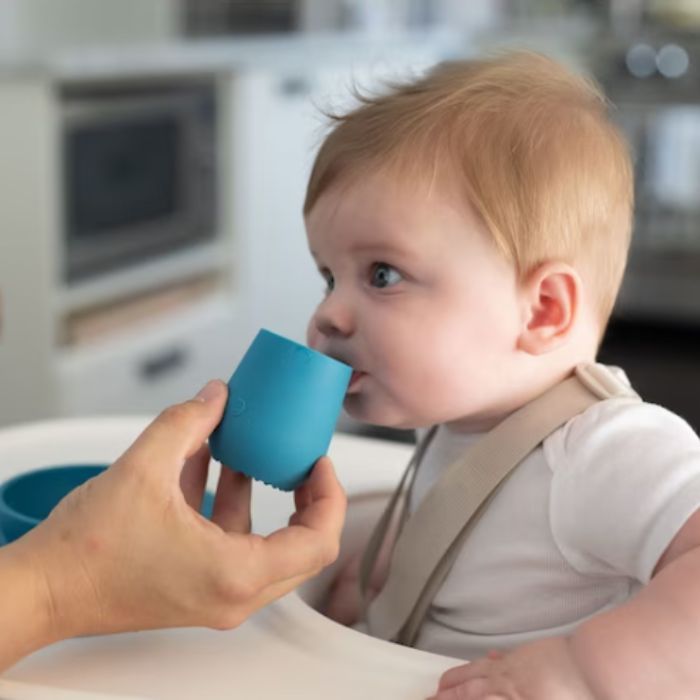
ezpz Tiny Cup
ezpz has a whole line of high quality, food-grade silicone feeding products that were developed with the help of a Pediatric Feeding Specialist.
The Tiny Cup can be used from 4+ months and has a weighted base and tactile bumps that provide topple resistance. If you’re shopping for an older child, check out the Mini Cup + Straw. You can find it on the ezpz site. (You can also find them on Amazon and at Target.)
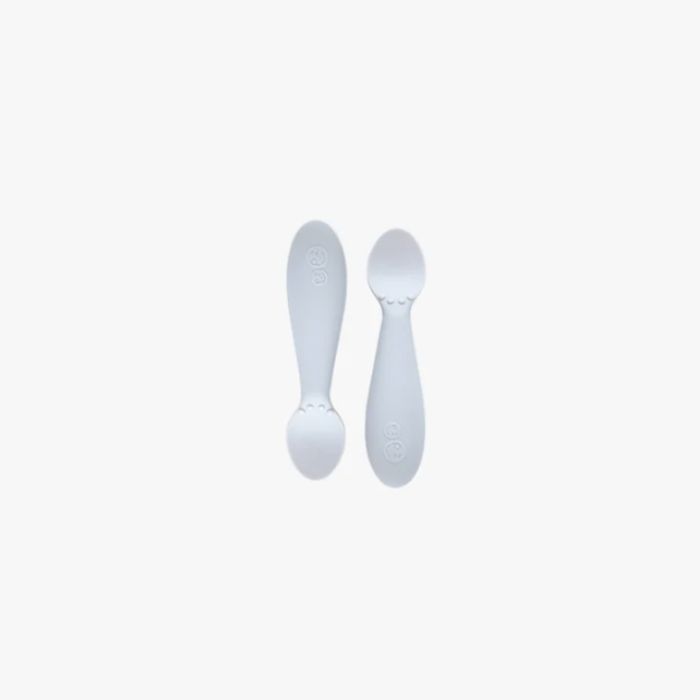
ezpz Tiny Spoons
The Tiny Spoons from ezpz have sensory bumps on the spoon bowl that activate sensory awareness to decrease gagging and choking. You can find them all on the ezpz site. (You can also find them on Amazon and at Target.)
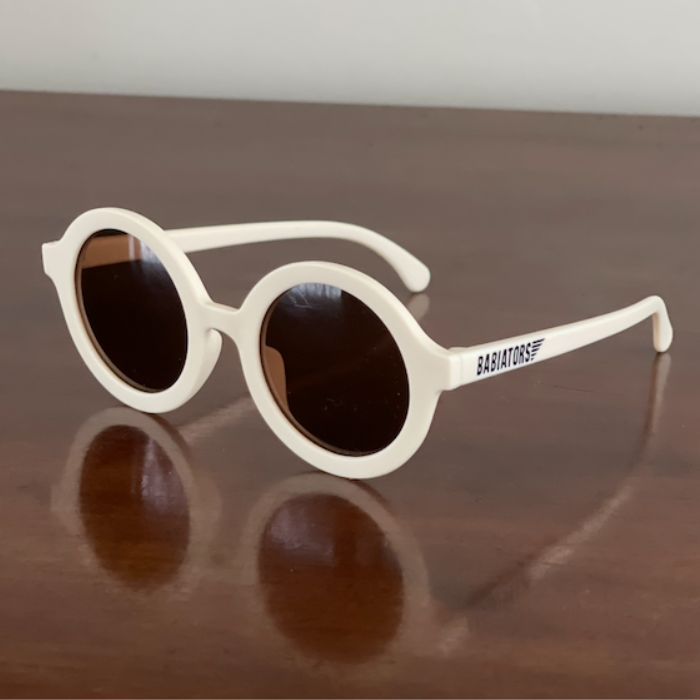
Sunglasses
I don’t think there is anything cuter than a baby wearing sunglasses. Cuteness aside, sunglasses help protect fresh little eyes so you want to make sure they have UVA & UVB protection. I love Babiators because they are well made, come in a ton of styles and are very durable. You can find them on the Babiators site, Amazon and at Target.
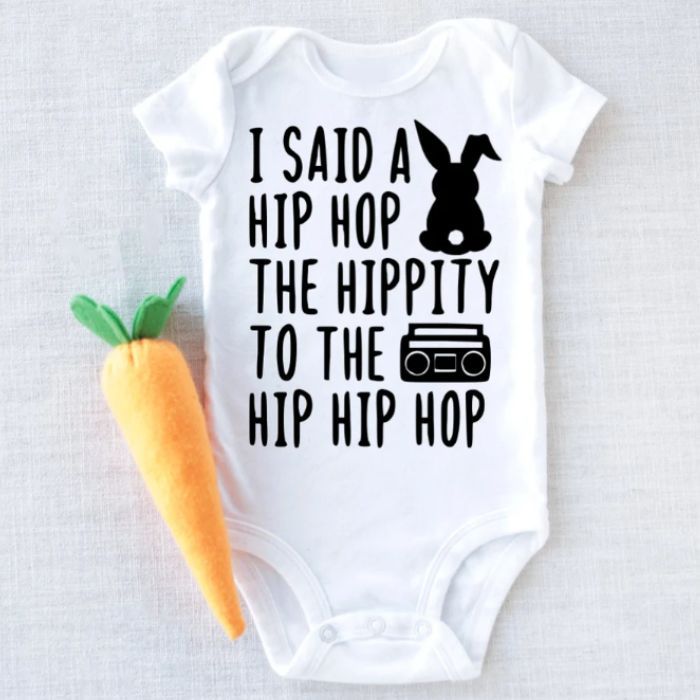
Hip Hop Onesie
Here’s a hopping graphic onesie idea for baby from Etsy. There are a handful of designs from different sellers that will speak to just about anyone’s inner ’90s hip hop fiend. You can check them all out on Etsy.
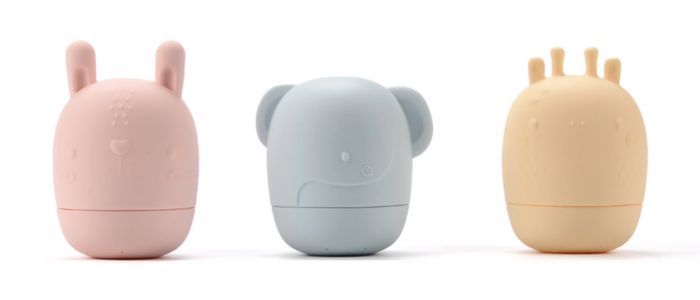
Bath Toy Set
These sweet bath toys from Loulou Lollipop open up so gross stuff won’t grow in them. They are the perfect size for small hands to grip and spray. You can find them on the Loulou Lollipop site and on Amazon.
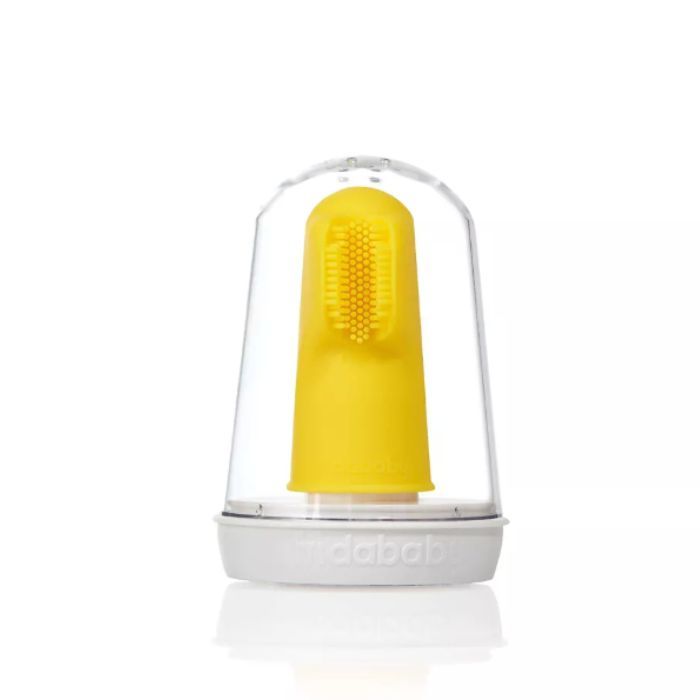
Fridababy Toothbrush
I fully recognize that this little toothbrush isn’t a bunny or anything but I thought it had a bit of an egg vibe. The SmileFrida Finger Brush tackles top and bottom at the same time. Plus, a gentle massage with the Finger Brush can go a long way in alleviating teething woes. You can find it on Amazon and Target.
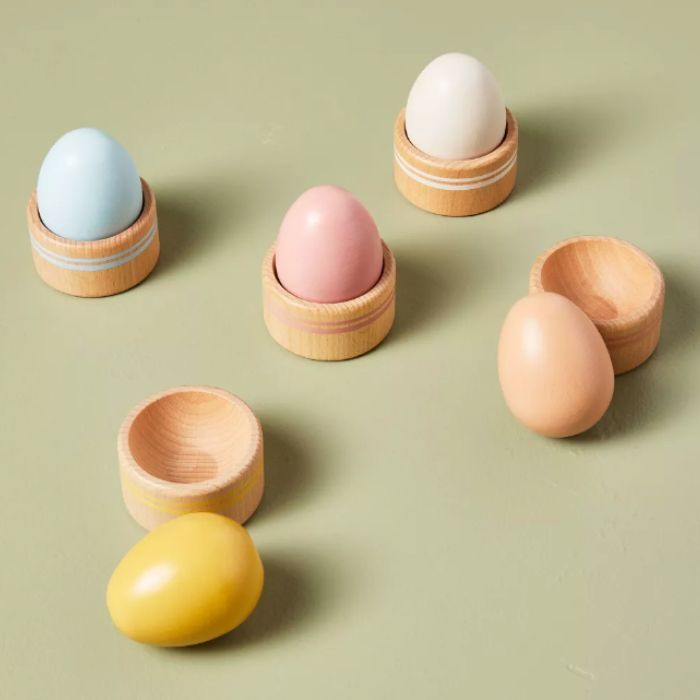
Wooden Play Eggs
This game set includes five wooden eggs and five wooden egg cups to help promote hand-eye coordination. They come in a nice, long package that will sit nicely in an Easter basket too. You can find them at Target.
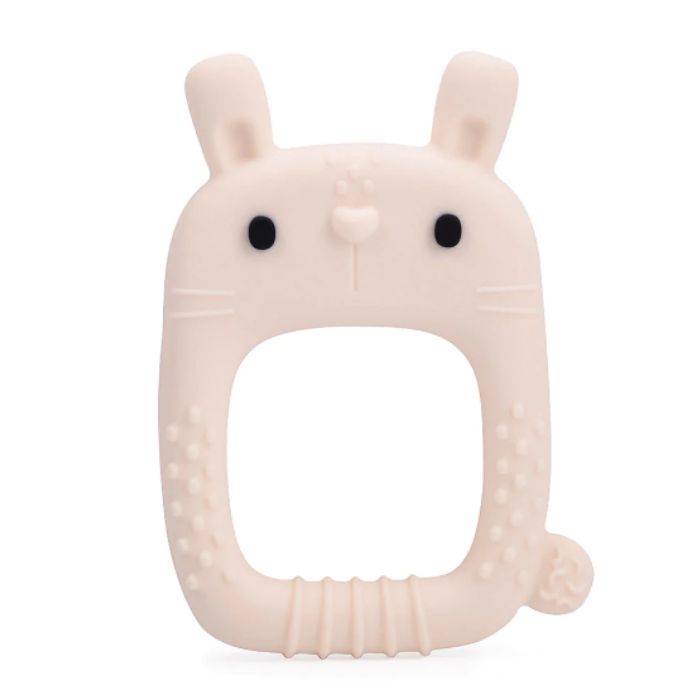
Bunny Teether
This little fella is textured on both sides for teething relief and has a nice shape for easy holding. It’s free of BPA, PVC, phthalates, lead, and cadmium and they also make other animals like alligators, elephants, giraffes, llamas, lions and rhinos. You can find it on the Loulou Lollipop site and on Amazon.
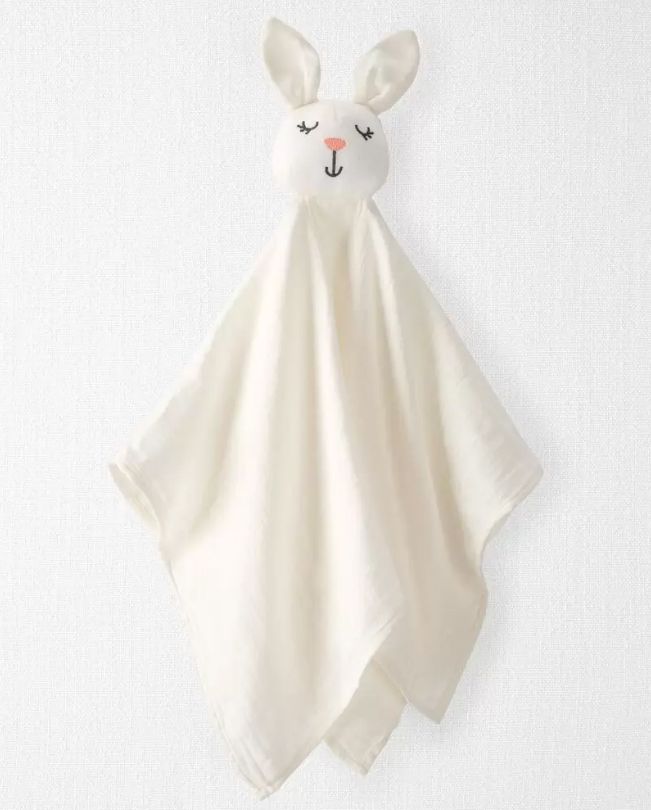
Bunny Lovey
This adorable Organic Cotton Muslin Bunny Lovie is so sweet. It comes wrapped to fit perfectly in an Easter basket too! You can find it on Carter’s website.
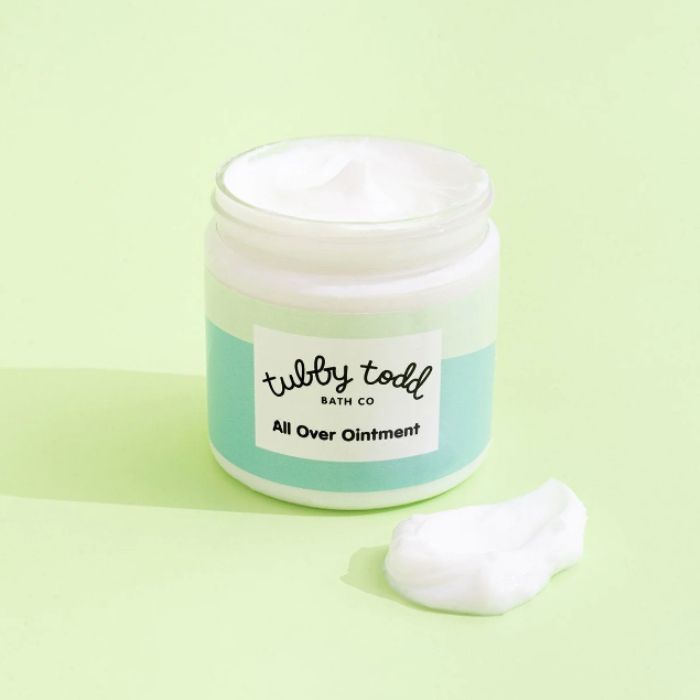
Tubby Todd All Over Ointment
This stuff is amazing and the green label gives it a spring vibe. You can shop it on their website and you can also read my review here.
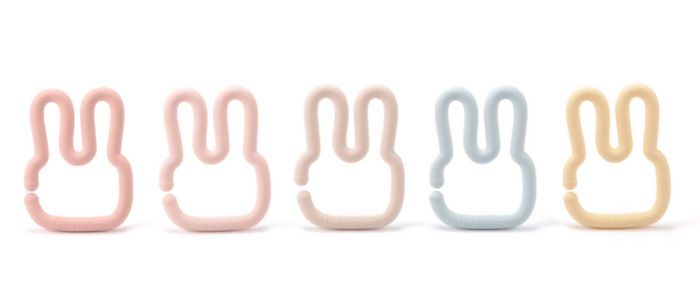
Bunny Toy Links
These Loulou Lollipop bunny links are ideal for attaching toys and teethers to the stroller, play gym, carrier, or car seat helping keep baby’s favorite toys off the floor while providing hours of entertainment. It comes in a pack of five in an adorable bunny shape which is perfect to tuck in an Easter basket. You can find them on the Loulou Lollipop site
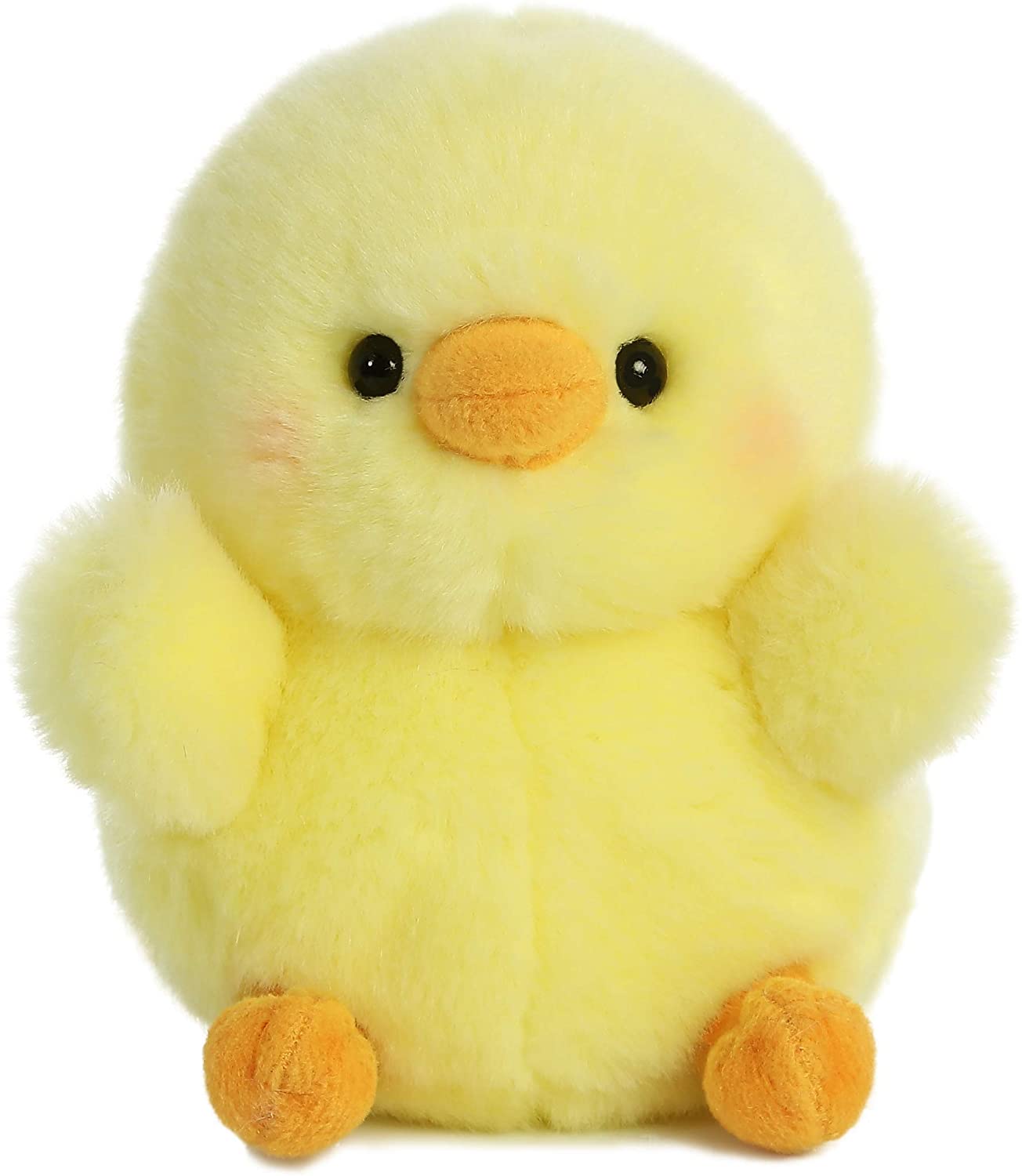
Stuffed Chick
How sweet is this little puff?! This sweet chick is only 5″ tall so its easy for little hands to hold and cuddle. You can find it on Amazon and Target.
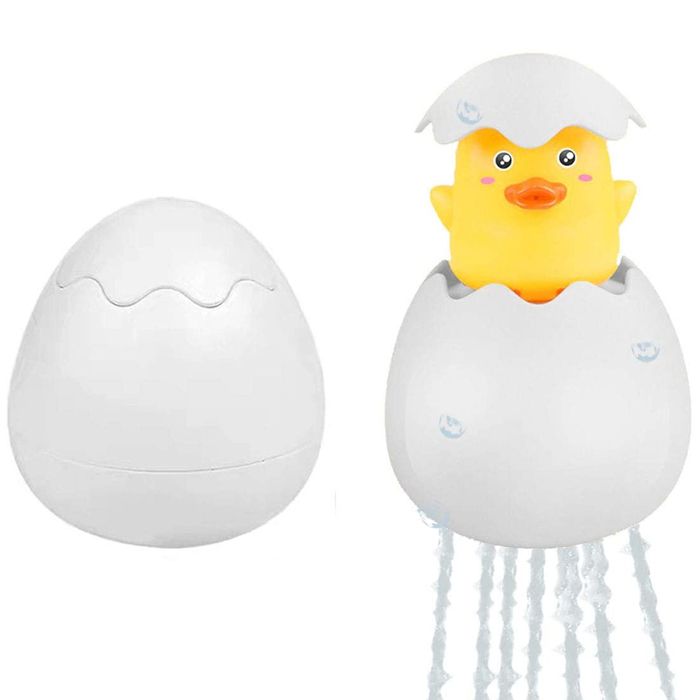
Hatching Duck Bath
When the egg is filled with water, the little duck slowly pops up. Water squirts out of its mouth when you push it back in. Pick the egg up and water sprinkles out of the bottom. You can find it here on Amazon.
Personalized Labels
Great for sippy cups, jackets, shoes and anything else that tends to walk away. They are printed on a sheet so they’d sit nicely in an Easter basket. Minted makes beautiful ones.
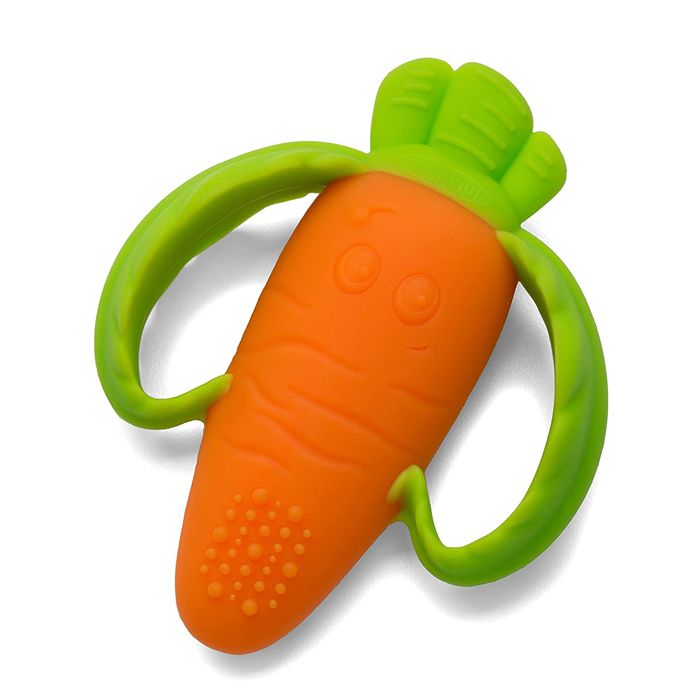
Carrot Teether
New chompers will love this sweet little carrot teether. You can find it on Amazon and Target.
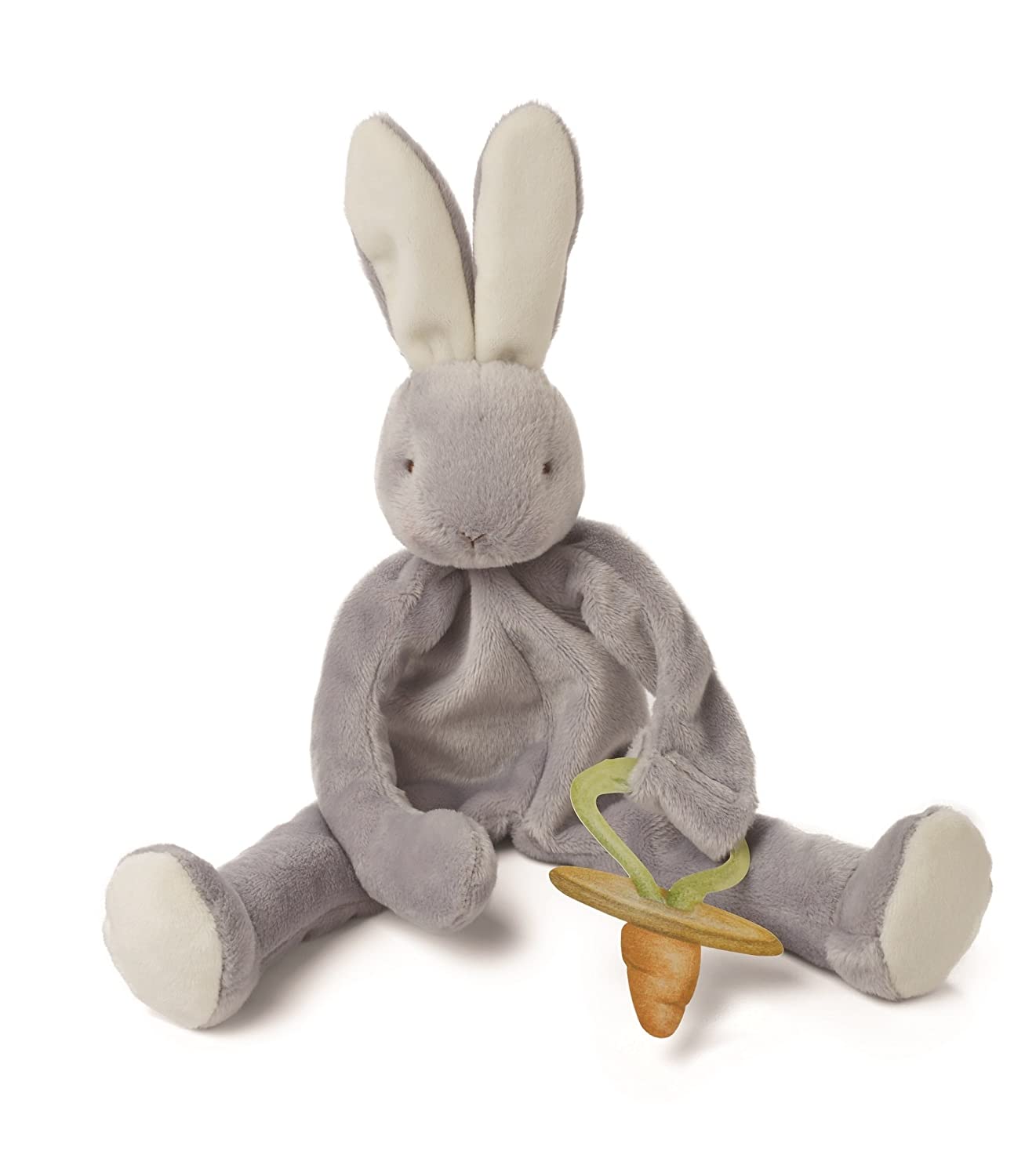
Bunny pacifier holder
This sweet bunny has a velcro hand to hold a favorite pacifier or teether. You could even pair it with the carrot teether! You can pick it up on Amazon.
Note: skip sleeping with this bunny when it comes to young babies who don’t roll.
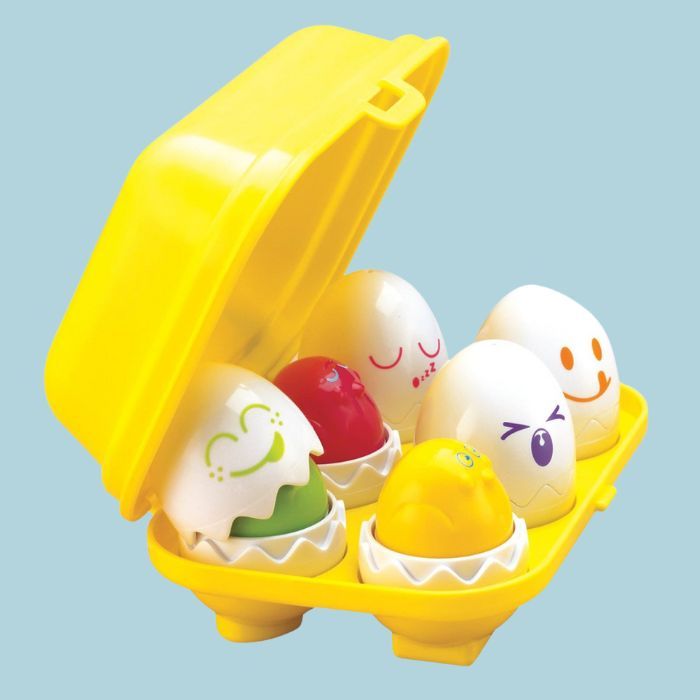
Hide N Squeak Eggs
This timeless toy contains six eggs that crack open to reveal colored chicks that chirp gently when their heads are pressed down. Each little egg has a shape on the bottom that fits into its unique base in the egg box. You can find them on Amazon and Target.
Babyganics SPF 50 Baby Mineral Sunscreen Lotion
Celebrate the sunny spring with this mineral sunscreen that is made with all mineral actives: zinc oxide and titanium dioxide, and without parabens, phthalates, PABA, fragrance, or nanoparticles. (And the packaging looks nice in an Easter basket.) You can find it on Amazon and at Target.
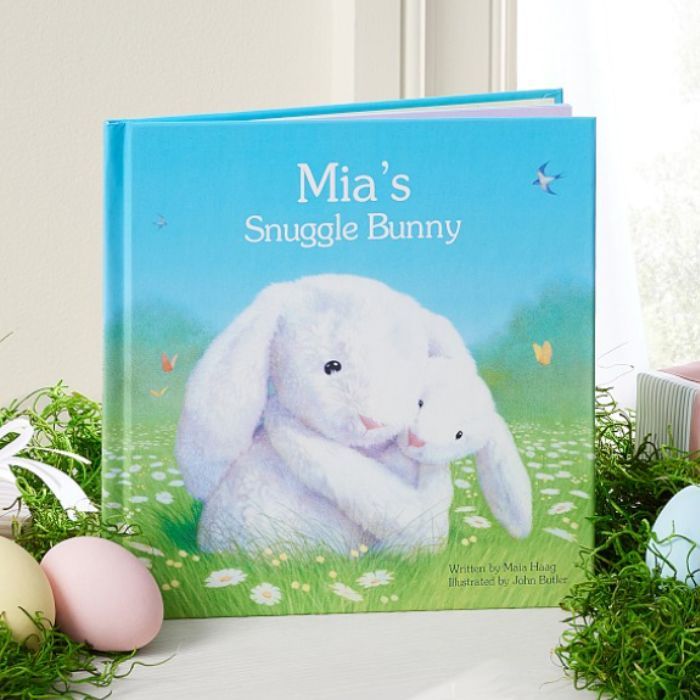
Personalized Board Book
Little readers will enjoy following the Snuggle Bunny putting away toys, brushing teeth, and sharing lots of snuggles before settling down to close their eyes. I found this one at Pottery Barn Kids.
Portable Sound Machine
Okay, so this sound machine isn’t exactly an egg, but I thought it had an Easter vibe. The little speaker has 4 relaxing sound options – Heartbeat, White Noise, Ocean, or Lullaby – and easily fits in diaper bags and luggage. You can find it on Amazon.
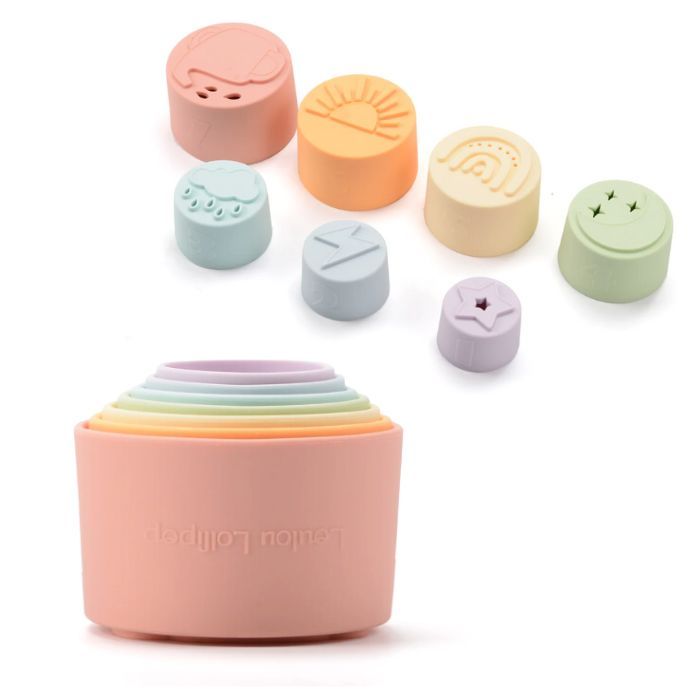
Stacking Cups
These silicone stacking cups come in two color sets and can be used for playtime or bathtime. They are softer than your regular stacking cups so they stack better and aren’t as loud (or frustrating) when they tumble. You can find them on Loulou Lollipop site.
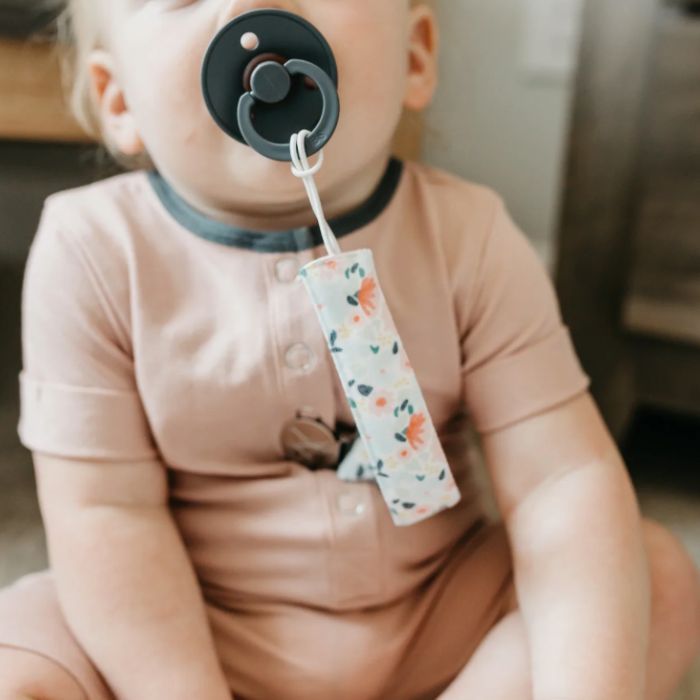
Binky Clips
Copper Pearl makes these adorable Binky Clips in sets of three. They feature a premium knit strap lined with absorbent fleece to help soak up drool and attach to a baby’s pacifier or teether at one end, then fasten the clip to clothing, blankets or baby gear on the other. The set here is called Leilani on the Copper Pearl site, but Amazon also carries other patterns.
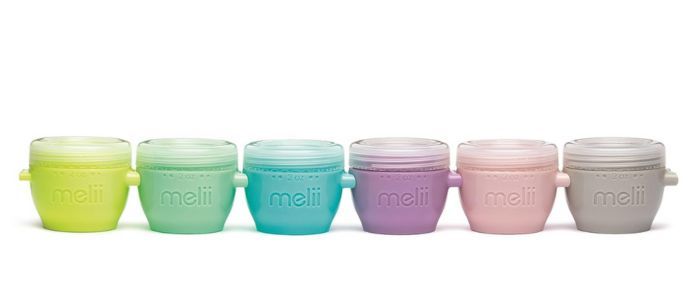
Snap and Go Pods
These Snap and Go pods are great for snacks, formula storage, baby food and more. They are made by Melii (they make my favorite snackle box) and come in a BPA-free plastic version and a silicone version and a silicone version.
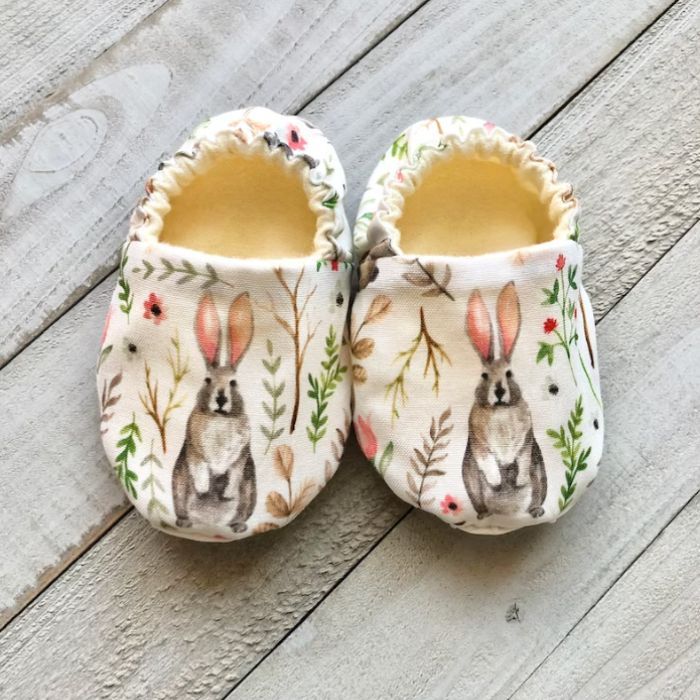
Crib Shoes
Style your little Easter Egg in some fresh bunny shoes. There are tons of beautiful ones on the Etsy site.
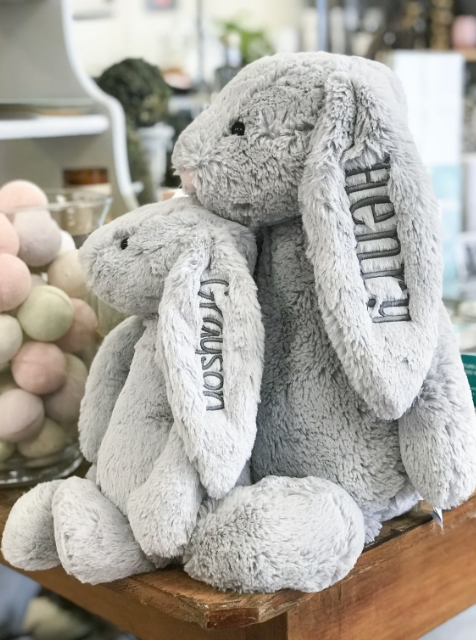
Personalized Jellycat
Who doesn’t love a personalized bunny?! These Jellycats are timeless and are a sweet keepsake for a baby’s first Easter. You can find these in the Embelish Monograms shop, but Etsy has various options if you’re looking for a specific style or color.
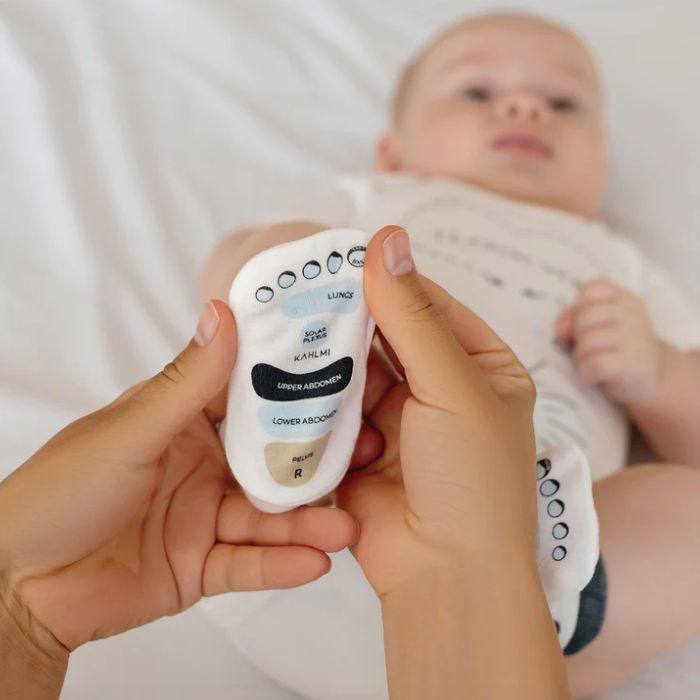
Kahlmi Massage Me! Socks
These too-cute baby massage socks feature clearly printed instructions so you can unlock the benefits of reflexology to soothe a baby’s gas, colic and constipation. Find them on Kahlmi and Amazon.
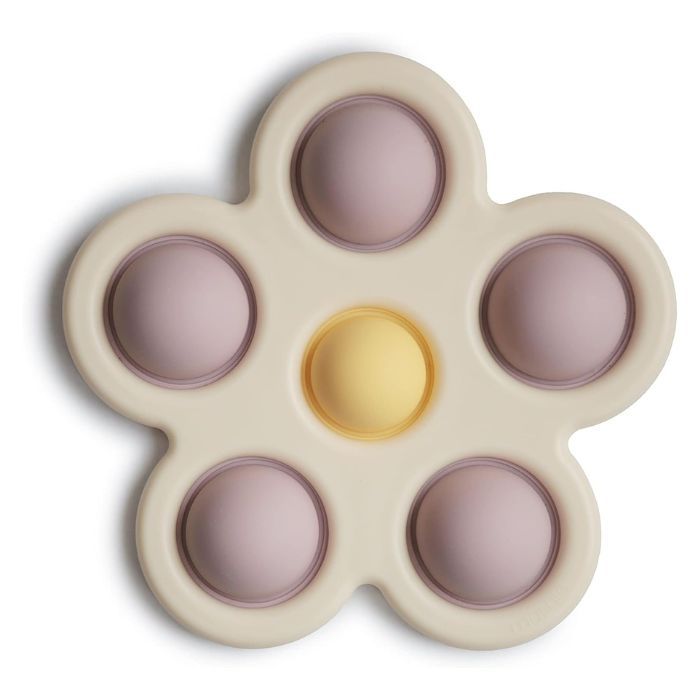
mushie Flower Press Toy
This sweet little flower encourages sensory exploration and the development of fine motor skills with its simple design and soft colors. It’s made from food grade silicone and a BPA-free plastic frame. You can find it in a variety of colors on Amazon

Knitted Bunny Hat
What’s an Easter photo without them? We found these from Marys Knits on Etsy.
Baby Bandana Drool Bib
Copper Pearl makes gorgeous bibs. I like that they are seasonal without being too on the nose so it doesn’t feel weird like when you are using a “My First Christmas” bib in July. I know it doesn’t matter but, you know, the little things. You can find this “Peter” set on Amazon and the Copper Pearl site. (Target also carries them but I couldn’t find this exact pattern.)
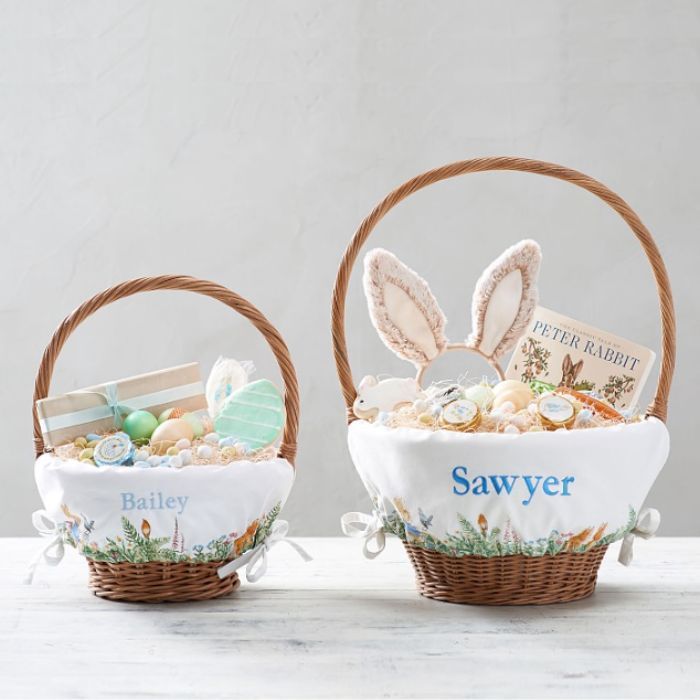
Custom Easter basket
I love these because they aren’t too ‘babyish’, so they can use them for many years to come. Pottery Barn has a beautiful assortment of designs and sizes. You can shop them all here on Pottery Barn Kids.
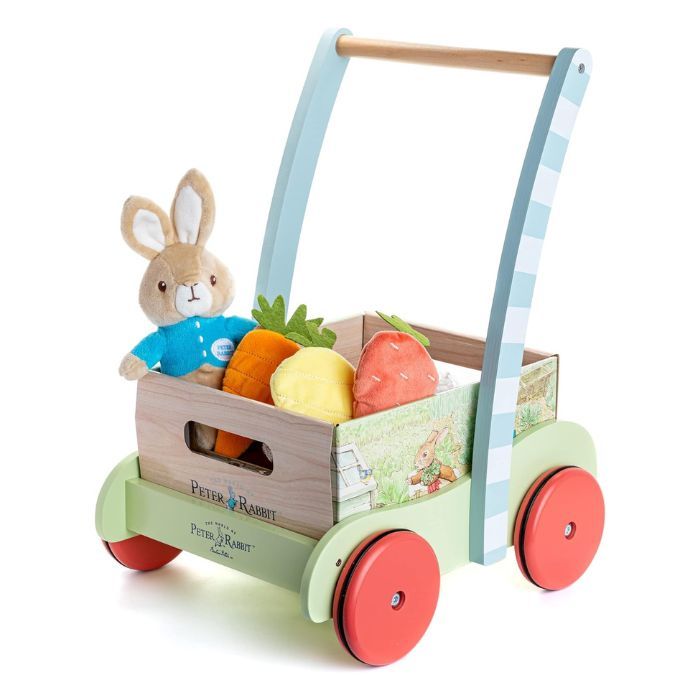
Peter Rabbit Wooden Garden Wagon
If you want to skip the Easter Basket and go with something more substantial, this little wooden wagon comes with a removable cardboard crate and plush toys. You can find it on Amazon.
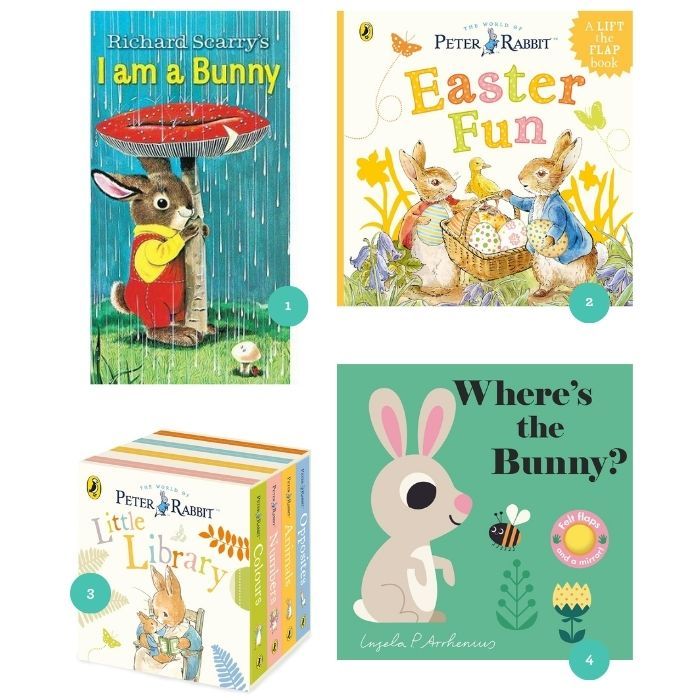
Easter Board Books
Some of these are specific to Easter and some just have bunnies and ducks, but ALL of them are good. Also, check out the full list of Easter Board books. I spent a full afternoon narrowing down the pile to my top 21 picks. Here are four of them:
- I Am a Bunny (This is the BEST book) Amazon | Target
- Peter Rabbit Easter Fun Amazon
- Peter Rabbit Little Library Amazon
- Where’s the Bunny? Amazon | Target
There are tons of fun ideas for a baby’s Easter basket
Just because they aren’t old enough to rock the jelly beans doesn’t mean they can’t have some amazing treats and they’ll definitely know the most important thing this holiday week – Somebunny loves them. Now excuse me while I finish this bulk bag of mini-eggs and pin all things Peter Rabbit.
Related: 40+ First Easter Baby Photo Shoot Ideas You Can Do at Home
I’ll never forget the well-meaning coworker who showed up unannounced three days after I brought my firstborn home. She arrived with a cold, stayed for two hours, and expected me to make coffee. I spent the visit fighting back tears of exhaustion while she dominated the conversation with unsolicited advice.
That experience taught me everything about what NOT to do when visiting a newborn. After writing about pregnancy for over a decade and navigating two of my own newborn phases, I’ve learned that the difference between a welcome visit and a stressful one comes down to a few crucial principles.
The Golden Rule: It’s About Them, Not You
Visiting a baby is a privilege, not a right. New parents are navigating sleep deprivation, physical recovery, feeding challenges, and keeping a tiny human alive. Your excitement doesn’t automatically entitle you to a meet and greet.
Wait for the invitation. Never drop by unannounced – not to the hospital, not to their home, not even if you’re “just in the neighborhood” with muffins.
Try this approach: “I’m so excited to meet [baby’s name] whenever you’re ready! No rush at all – just let me know when visitors would be helpful rather than overwhelming.”
Even if you’ve scheduled a visit, text 30 minutes before you leave: “Still good for our 2 PM visit? And can I grab anything from Target on my way?” New parents exist in a timeless fog where scheduled visits can slip their minds, and that heads-up gives them a chance to reschedule guilt-free (or put a bra on).
Before You Visit: Health and Safety Non-Negotiables
Newborns have developing immune systems and haven’t received most vaccinations yet. Your first job is protecting that vulnerable baby.
Cancel your visit if you:
- Feel even slightly under the weather (scratchy throat, mild congestion, fatigue)
- Have been around sick people in the past week
- Had a cold or flu – wait at least one full week after recovery
I missed meeting my friend’s daughter by two weeks because I had a lingering cough. But that baby is now five, and I’ve been at every birthday party since. Short-term sacrifice, long-term relationship.
When you arrive:
- Wash your hands immediately with soap and water for 20 seconds – before anyone asks
- Skip the fragrance (no perfume, no scented lotions)
- Do not kiss the baby. Not on the face, not on the hands, nowhere. Even if you feel healthy, you can transmit viruses like RSV or HSV that cause serious illness in newborns. You can read more about it here.
Your Visit Game Plan
There’s a crucial difference between being a visitor and being a helper. A visitor requires entertainment. A helper reduces the workload. Here’s how to be the latter:
Bring Food, Not Flowers
The most helpful thing you can bring:
- Complete meals ready to heat and eat
- Freezer-friendly dishes
- Healthy snacks you can eat with one hand
- Restaurant gift cards or food delivery credits
Always check for dietary restrictions and ask what they’re craving. One friend told me she was desperate for fresh fruit. Another wanted nothing but carbs.
When You Arrive: Offer Specific Help
Don’t say “Let me know if you need anything!” Most exhausted parents won’t take you up on this.
Instead, try:
- “I’m at the grocery store, can I grab milk, diapers, or anything else?”
- “I’m bringing dinner Thursday. Chicken pasta or veggie stir-fry?”
- “If you want to take a long shower or have a nap, I’m completely comfortable here with the baby.”
- “I’d love to help out while I’m here. What would make the biggest difference? Dishes? Laundry? A grocery run?”
Hold the Baby Only If Offered
Never assume you can hold the baby. Wait until a parent offers. New parents are navigating intense bonding hormones, healing bodies, and anxiety about germs. They may not want to hand over their baby, and that’s their right.
If you are offered baby snuggles: wash your hands again, always support the head and neck, sit down, and hand them back if the baby starts to cry.
What to Talk About (And What to Avoid)
Don’t ask:
- “Are you breastfeeding?” → Feeding choices are deeply personal and often fraught.
- “Is the baby sleeping through the night yet?” → Newborns don’t sleep through the night; it’s developmentally normal.
- “Did you have a natural birth?” → Technically, I would argue that all birth is natural, plus, birth stories can be traumatic. Let parents decide if and when to share.
- “Don’t you just love being a mom?” → Not all parents bond immediately. Some experience postpartum depression.
Avoid commenting on:
- Her body (“You look so tired,” “When will you lose the baby weight?”)
- Her house (“Wow, it’s really messy in here!”)
- Her parenting (unsolicited advice, “In my day we did it this way…”)
Safe, supportive conversation starters instead:
- “The baby is absolutely beautiful. Those tiny fingers!”
- “How are you feeling? Really – no pressure to say ‘fine’ if you’re not.”
- “Tell me about [baby’s name]’s personality so far. Are they calm? Feisty?”
- “What’s been the biggest surprise so far?”
- “Do you feel like talking about the birth, or would you rather I catch you up on normal life stuff?”
The golden rule: Follow their lead. If they want to vent about cracked nipples and sleep deprivation, listen. If they want to talk about literally anything other than the baby, give them that gift.
Social Media Boundaries
NEVER post photos of someone else’s baby without explicit permission. This is the parents’ news to share on their timeline.
When to Leave (And Why Coming Back Matters More)
A good visit lasts 30 minutes to an hour – not three hours.
Signs it’s time to wrap up: parents start checking the time, mom looks uncomfortable, baby needs to eat or sleep, or the conversation naturally winds down.
Before you leave: “I don’t want to overstay. Would it be helpful for me to stay a bit longer, or is this a good stopping point?”
The 4-week follow-up: Here’s what most visitors don’t realize: By week four, the visitors stop, the meal train ends, and the reality of long-term sleep deprivation sets in. That’s when new parents need you most.
Set a reminder for four weeks after birth, then reach out: “Thinking of you! Can I bring over dinner this week?” This second visit means more than the first one.
The Real Secret
The visitors new parents remember fondly are the ones who made their lives easier, not harder. They showed up with food, respected boundaries, kept visits short, and returned during the harder weeks that followed.
Quick Recap:
DO:
- Wait for an invitation
- Confirm you’re healthy and vaccinated
- Wash your hands immediately
- Bring food or practical help
- Keep visits under an hour
- Follow up in a few weeks
DON’T:
- Visit if you’re even slightly sick
- Kiss the baby
- Drop by unannounced
- Post photos without permission
- Comment on her body, house, or parenting
- Overstay your welcome
Following these guidelines isn’t about walking on eggshells; it’s about recognizing that this tender postpartum period is unlike any other time in a family’s life. The new parents in your life are lucky to have someone who cares enough to get this right.
Now go be the visitor they actually want to see… just call first.
You might also find these posts helpful:
Look, we get it, babies are cute. Those sweet cheeks, that sweet baby smell, those tiny fingers wrapped around yours – it takes everything not to smother them with kisses. (They really are yummy.)
But a baby's immune system is brand new, like, literally just unpacked from the box. What reads as a minor sniffle to you could land a newborn in the hospital.
Let's break down exactly why those kisses need to wait, and why baby kisses are riskier than you think.
It All Comes Down to Germ Transfer
When someone kisses a baby – especially on or near the face – they're potentially transferring bacteria and viruses that their adult immune system handles just fine, but a baby's developing system can't fight off yet.
The even trickier part is that many people don't even know they're contagious.
The relative who "just has allergies"? Could be early RSV. The neighbor who had a cold last week and feels fine now? Still potentially shedding virus. That friend who swears they never get cold sores? They might carry HSV-1 without symptoms.
The risk isn't a baby getting a little sniffly. We're talking about serious infections that can affect their brain, lungs, and other vital organs during those first months when they're most vulnerable.
The 4 Biggest Risks When Someone Kisses a Newborn
1. RSV (Respiratory Syncytial Virus)
This is the big one, especially right now. A 2024 study that followed over 2.3 million children born in Sweden found something shocking: even healthy, full-term babies with no underlying conditions ended up in intensive care with severe RSV.
The median age of the sickest babies? Just under two months old.
For adults, RSV symptoms are so mild you might think it's just a stuffy nose or slight cold. But for babies, RSV can mean:
- Difficulty breathing and rapid breathing
- Severe dehydration
- Hospital admission (2.8% of RSV-infected infants were hospitalized)
- ICU stays with oxygen support
- In rare cases, death
Babies born in winter months or those with siblings under 3 have a threefold higher risk, and prevention is infinitely easier than treatment.
The good news: RSV hospitalizations have dropped since vaccines became available. But that doesn't mean a baby is automatically protected – especially in those first vulnerable months.
2. Herpes Simplex Virus (HSV-1)
About 67% of adults under 50 carry HSV-1, the virus that causes cold sores. Many don't even know they have it because they've never had an outbreak.
Here's what makes it brutal for newborns: you can spread herpes even without an active, visible cold sore.
When a newborn contracts HSV-1, it's not just a blister on their lip. The virus can:
- Spread to their eyes, potentially causing vision problems
- Attack their central nervous system, leading to brain damage
- Cause herpes meningitis (inflammation of the brain and spinal cord membranes)
- Become life-threatening if it reaches their organs
- Leave permanent intellectual disabilities
We've all heard heartbreaking stories and the younger the baby, the more vulnerable they are. The first four weeks are the highest risk period, but you should curb the kisses for at least the first three months.
3. Hand, Foot, and Mouth Disease
This viral infection is incredibly common in daycare settings and among young children, but it's easily spread to babies through kissing or close contact. While it sounds relatively benign, HFMD causes:
- Painful ulcers and blisters in and around the mouth
- Rashes on hands, feet, and diaper area
- Fever and irritability
- Difficulty eating and drinking (which can lead to dehydration in infants)
As with many of these treats, someone can spread HFMD before they show any symptoms. So that well-meaning toddler who kissed a baby's hands yesterday? They might develop blisters tomorrow, but that baby could already be infected.
4. Their Barely-There Immune System
Let's talk about what's actually happening inside a newborn's body. For the first three months of life, babies have significantly fewer infection-fighting immune cells – specifically neutrophils and monocytes – compared to older children and adults.
Think of it this way: their immune system is like a security team that's severely understaffed. They're doing their best, but they're easily overwhelmed.
Bacteria that normally live harmlessly in an adult's body (like Group B streptococci (GBS) from the gastrointestinal tract or certain E. coli strains) can cause:
- Sepsis (blood infection)
- Pneumonia
- Meningitis (inflammation of brain and spinal cord membranes)
These aren't "baby got a cold" situations. These are "rush to the emergency room" scenarios that can have life-threatening consequences.
What About Parents Kissing Their Own Baby?
Great question. Parents can generally kiss their baby because:
- They're in constant contact anyway
- They share the same household germs
- They're hyper-aware of their own health status
So What Can You Do Instead?
The good news: there are tons of ways to bond with and show love to a new baby that don't involve face kisses.
Great alternatives:
- Hold their tiny hand or foot
- Snuggle them close (after washing your hands)
- Talk to them – babies love hearing different voices
- Give gentle head pats or back rubs
- Just be present – your company matters more than your lips on their face
The golden rules for visiting:
- Wash your hands when you arrive
- If you've been even slightly sick in the past week, reschedule
- If you have any active cold sore or feel one coming, definitely reschedule
- Save the face kisses for when baby's older
The Bottom Line: Their Baby, Their Rules
Parents don't need to justify protecting their baby.
Anyone who truly cares about that child's wellbeing won't be offended by being asked not to kiss them. And if they are? That's their problem, not the parents.
That baby will have their entire life ahead of them for kisses from loving family members. Right now, during these vulnerable first months, everyone's job is to protect that developing immune system.
There are a million ways to show love to a baby that don't involve putting your mouth on their face. Anyone who can't respect that can kiss an ass instead.
Also check out: Everything You Need to Know Before Visiting a Newborn